

I am Osama, and I run SamadMBBS with my co-founder Samad. We both did our own MBBS in Bangladesh, and between the two of us and our team, we have now personally guided well over a hundred Indian students through the process of studying medicine abroad and coming back to sit for FMGE. If you have landed on this page, there is a good chance you typed something like “I lost my NEET scorecard” into Google late at night, with an FMGE form sitting open in another tab and a rising sense of panic. So first, take a breath. Losing the PDF does not mean your NEET result has vanished. It means you need to work through the right channels, in the right order, and that is exactly what this guide is for.
We wrote this guide because this exact problem comes up constantly among the students we work with. An old NEET UG scorecard that nobody thought they would ever need again suddenly becomes the one document standing between a student and their FMGE registration, years after the exam. So we sat down and did this properly. We read NTA’s official RTI page, NTA’s duplicate score card notice of 17 September 2026, checked NBEMS’s FMGE notices across several sessions, and read the actual Delhi High Court orders from late 2025 and 2026 that dealt with exactly this situation, on Indian Kanoon and through court reporting from Verdictum and Medical Dialogues. Every factual claim below is either linked to its source or clearly marked as an example rather than a rule. Where something genuinely is not published or guaranteed anywhere, we say so instead of guessing, because guessing on a document you need for FMGE is not something we are willing to do to you.

Quick answer
Yes, a lost NEET UG scorecard can usually be recovered or officially verified. Start with your registered email, then check DigiLocker and the official NEET website and archive. If the scorecard is still unavailable, NTA now has an official duplicate score card procedure (notice dated 17 September 2026) that you can use if your result data is still held in NTA’s records and is not already on DigiLocker. If that route does not resolve it, contact NTA directly or consider RTI. If the scorecard is old and you specifically need it for FMGE, there are also documented 2025-2026 Delhi High Court cases where NTA furnished a candidate’s available database records to the court, and the court then directed NBEMS to treat that order as the scorecard. That is real relief, but it is case-specific relief that a court granted after a petition was filed, not an automatic guarantee. There is also good news on the horizon: as of July 2026, NTA has told a government oversight body that a DigiLocker-based system for retrieving older scorecards is close to launch, which we explain further down this guide.
At a glance: what to try, based on what you still have
Before we walk through every step in detail, here is a fast overview. Find the row that matches your situation and start there. You can always come back and read the fuller explanation for that step further down the page.
What is a NEET UG scorecard, and why does it come back to haunt people years later?
Your NEET UG scorecard is the official document NTA issues once your result is declared. It shows your score, your percentile, your rank, and whether you qualified. Most students download it exactly once, use it for their admission paperwork, and never think about it again. That is completely normal. The problem shows up years later for one specific group of people: Indian students who went abroad for MBBS and are now applying for FMGE, because FMGE eligibility is tied to proof that you actually qualified NEET UG. A document you filed away in 2019 or 2020, back when you had no reason to imagine you would ever need it again, suddenly becomes something you must produce in 2026, often for a phone or laptop you no longer even own. If that is exactly where you are right now, you are far from the only one. Keep reading.
Step 1: Search everywhere the original PDF could still be
Before you contact anyone official, spend twenty minutes actually looking. This sounds obvious, but skip it and you will regret it, because old NEET documents are usually sitting somewhere you simply have not checked recently. Start with the places where your original scorecard is most likely to be available. Check your old email account first, not necessarily the email you use every day now, but whichever address you registered on the NEET application form. Then check your phone and any cloud storage you were using around your NEET year. After that, check any old device you still have access to, and any printed admission file from your college, since even a photocopy can help confirm your exact NEET details later if you need to write to NTA.
- Search your registered email, not just your current everyday inbox, for the words “NEET”, “NTA” and “score card”, along with your roll number. Check the Spam folder, the Trash folder and any Archive folder, not just the main inbox.
- Check your phone’s Downloads and Documents folders, since some students saved the PDF locally and never opened the email again.
- Check Google Drive, OneDrive or any cloud storage account you were using around your NEET year.
- Search old WhatsApp chats where you may have sent the PDF to a parent, a sibling or a consultant at the time.
- Check an old laptop or an external hard drive, if you still have access to one.
- Look through any printed admission file from your college. Even a photocopy is useful, because it can help confirm your exact NEET year, roll number and score if you end up needing to write to NTA.
One important rule before you go any further. Never edit an old scorecard PDF to “fix” a blurry field or to recreate a cleaner-looking copy, even with good intentions. NEET’s Information Bulletins list manipulation or fabrication of documents, including admit cards, rank letters and self-declarations, as an unfair means practice, and this is treated seriously. Whatever original file you do find, keep it exactly as it is. If it is blurry or incomplete, that is a problem to solve through the official channels below, not with an editing tool.
Step 2: Check DigiLocker
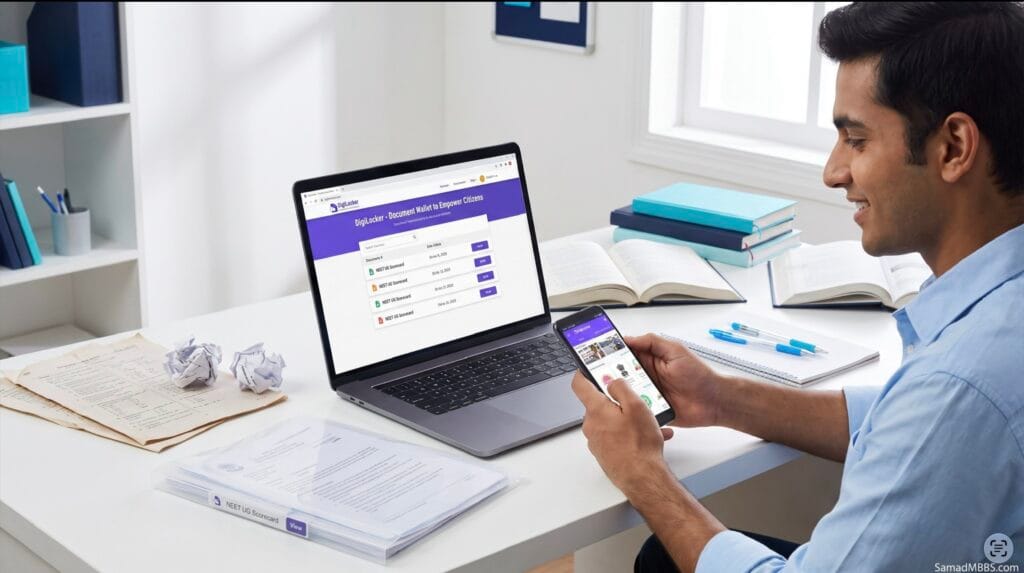
This step is genuinely worth doing before anything else official, and here is exactly why it works. NEET’s Information Bulletins, in the chapter dealing with the safe custody of examination documents, state that scanned copies of your OMR Answer Sheet and Score Card are kept in the safe custody of DigiLocker, based on the consent you gave during your original online application. If you do not already know what DigiLocker is, it is a government-run digital locker service where certain official documents, issued by government bodies and examination authorities, are stored on your behalf and linked to your Aadhaar or mobile number. The same bulletin adds something genuinely useful: if you have forgotten your NEET portal User ID or Password, you can retrieve your Application Number or your Registered Mobile Number through your DigiLocker account, and that in turn can unlock the rest of your NEET records elsewhere.
- Sign in to your DigiLocker account, using whichever mobile number or Aadhaar you linked to it around the time of your NEET application.
- Open the “Issued Documents” section and search for NTA or NEET.
- If your Confirmation Page, Admit Card, OMR sheet or Score Card is listed there, download it immediately and back it up in at least two separate places, such as your email and a cloud drive.
- If nothing shows up, do not assume that means NTA has no record of you at all. It may simply mean this particular route has not been fully extended to your NEET year yet, something that is actively changing, as the next section explains.
Good news: NTA is building a permanent DigiLocker fix for old scorecards
This is a genuinely important, very recent development, and we have not seen many other guides mention it yet. In July 2026, NTA informed the Central Information Commission, the body that hears appeals under the RTI Act, that it was “in the process of devising a mechanism with DigiLocker to enable retrieval of scorecards of previous years by the candidates,” and that this work was “attaining to reach the final stage and is likely to be completed at the earliest.” This came out during the hearing of an RTI appeal filed by a NEET UG 2020 candidate who needed a certified copy of her scorecard for FMGE eligibility verification, a situation that will sound very familiar if you are reading this guide.
In that same case, NTA told the Commission it could not hand over the appellant’s NEET UG 2020 scorecard because, under Clause 15.6 of the relevant Information Bulletin, examination records are preserved for only 90 days after results are declared, and hers had already been weeded out before her RTI application was filed. The Information Commissioner accepted NTA’s position on that point, noting that a Central Public Information Officer can only provide information that is actually held in office records, and is not obliged to create information that does not exist under the RTI Act. That distinction matters, and we come back to it in the RTI section below.
What this means practically for you: the specific problem this entire guide is about, being unable to retrieve an old NEET scorecard for FMGE, is now something NTA itself has formally acknowledged to a government oversight body, and it says a fix is close. We cannot tell you exactly when this new DigiLocker mechanism will go live, since NTA has not published a firm date, and “in its final stages” is NTA’s own description, not ours. NTA’s 17 September 2026 duplicate score card memorandum repeats the same direction: it says NTA will move historical scorecards of eligible examinations onto DigiLocker in phases, and that its new duplicate procedure stops applying to any examination and year once that scorecard is available through DigiLocker. That memorandum gives no dates either. Once the DigiLocker rollout reaches your year, it should make several of the steps in this guide unnecessary. Until then, everything below still applies, and it is worth checking back on DigiLocker periodically if your FMGE timeline allows for that.
Step 3: Check the official NEET website and its archive
The current official NEET website has a dedicated scorecard section for the current examination year, and in some years has provided archive access for older examinations. This distinction matters more than it sounds like it should. An archive existing for your examination year is not the same thing as your individual scorecard actually being downloadable from that archive. Use only official NTA and NEET domains for this step. A search engine result full of coaching websites and unofficial “result download” pages will come up no matter what you search for, and none of those should ever be treated as a source for an official scorecard. If you are not sure whether a website is genuinely official, look for the “.nic.in” or “.ac.in” domain that government examination bodies typically use, and cross-check the link against the official sources list near the end of this guide.

What does it mean if the old portal no longer lets you download your scorecard?
This is where most students get genuinely confused, so it is worth explaining clearly and calmly. A website that no longer shows your old download link does not, by itself, prove that your examination record has been destroyed or deleted somewhere in NTA’s systems. It only means that the self-service download route is not currently working for you, for whatever reason, whether that is an archived login system, an expired session, or simply a portal redesign that dropped older years. There is a real difference between losing access to an old PDF and the underlying examination record that NTA itself holds. If the download link is gone, the right next move is to check whether your case fits NTA’s new duplicate score card procedure (Step 4 below), or to ask NTA directly what record or verification it can still provide for your specific year. It is not to assume the worst and panic before you have actually asked.
Does NTA delete NEET records after 90 days?
This particular point gets exaggerated a lot online, so here is exactly what the rule says, and just as importantly, what it does not say. Clause 15.6 of NEET’s Information Bulletin states that records and documents of that year’s examination are preserved only up to 90 days from the date the result is declared, after which they are weeded out, and that no information or correspondence will be entertained after that period on that basis. This is stated separately from the DigiLocker provision described above, which is meant to keep your scorecard and OMR sheet accessible through DigiLocker independently of that 90-day window, though as the July 2026 development above shows, that DigiLocker access has not yet been fully extended to every older NEET year.
In practical terms, this clause is really about NTA’s own internal record-keeping and correspondence window for that particular year’s examination cycle. It is not a blanket statement that your scorecard disappears from every single platform on day 91. It does, however, help explain why a fresh administrative request to NTA about a very old NEET year can be harder to resolve through ordinary email correspondence alone, which is exactly the pattern behind the court cases and the RTI case described elsewhere in this guide. So think of the 90-day clause as explaining why some doors get harder to open after a while, not as a rule that closes every door. NTA’s 17 September 2026 duplicate score card memorandum supports this: it says the new procedure applies notwithstanding the retention clause wherever the result data is in fact still available in NTA’s records. The 90-day rule therefore does not by itself close the duplicate route, but your result data still has to actually exist in NTA’s records for the route to work.
Step 4: NTA now has a formal duplicate score card procedure
This is the biggest change to this guide since we first published it. On 17 September 2026, NTA issued a Public Notice titled “Procedure for Issuance of Duplicate Score Card” and an Office Memorandum (F. No. NTA/OM/D/88/2026-ED-II) that sets out the full procedure. The memorandum itself says that no standing procedure had been prescribed before this for issuing a duplicate scorecard in such cases, and that NTA had been receiving representations from candidates of past examination cycles, mainly NEET UG candidates who studied medicine abroad and now need the document for FMGE and for NMC registration. So if you were searching for how to get a duplicate NEET scorecard, this is now the official NTA duplicate scorecard route, and it comes before writing a general enquiry to NTA, RTI or court action.
Please read the next few lines before you get too hopeful. This is a formal application with real paperwork, a fee and conditions. It does not promise that every candidate from every year will get a duplicate. It works only where your result data is actually held in NTA’s records, and NTA decides each application after verification. We have kept everything below to what the notice actually says. Where the notice does not say something, we say that too.
Does the NTA duplicate score card procedure cover a lost NEET UG scorecard?
Yes, NEET UG is named in the memorandum. It applies to all examinations conducted by NTA, and it lists NEET UG, JEE Main, CUET, UGC-NET and CSIR-NET as examples. Paragraph 1.3 specifically mentions NEET UG candidates who studied medicine abroad and need the document for FMGE (NBEMS) and for NMC registration. That makes this procedure directly relevant to a lost NEET scorecard for FMGE.
The scope has limits, and they matter for old NEET years:
- It applies only where the result data is preserved in NTA’s records and is not otherwise available to you through DigiLocker.
- If the data is not in NTA’s records, the memorandum says NTA will issue a reasoned certificate to that effect within the same timeline, and that no application fee will be retained.
- It is described as a residual channel. Once a scorecard for a particular examination and year is made available through DigiLocker, the procedure stops applying to that examination and year.
- NTA’s notice does not list which NEET years are covered. Its fee slabs go up to results declared 20 years ago, and whether your specific year works depends on whether NTA’s records still hold your result data.
Documents checklist for a NEET UG duplicate scorecard
These are the documents NTA’s notice requires with every application, in original or self-attested photocopy as indicated. This is more paperwork than most people expect, so start early. We have not added anything the notice does not ask for.
- Annexure I: the application form, duly filled and signed, with a recent passport-size colour photograph affixed.
- Annexure II: an affidavit on non-judicial stamp paper (value as prescribed in the State where it is sworn, not less than Rs. 10), attested by a First-Class Judicial Magistrate or a Notary Public. It declares the facts and circumstances of the loss, theft, damage or destruction, and undertakes to surrender the original scorecard to NTA if it is found later.
- Police or embassy report: a copy of the FIR, Daily Diary Report, Non-Cognizable Report or lost-article report registered with the police in whose jurisdiction the loss is said to have happened. Where such a report cannot be obtained (the notice includes loss abroad), an attestation by the Indian Embassy or Consulate of the country of residence.
- Two recent passport-size colour photographs: one on the application form and one on the affidavit, both attested by a Gazetted Officer or the head of the institution last attended.
- Identity proof: a self-attested photocopy of a government-issued photo ID (Aadhaar, PAN, Passport, Voter ID or Driving Licence), together with a self-attested photocopy of Aadhaar with masked digits. If you live abroad, a self-attested photocopy of your passport.
- Identification Certificate: Section I of the application form, signed and stamped by a Gazetted Officer of the Central or a State Government, or by the Principal or Head of the institution you last attended. The officer must personally know you. This is listed in the form’s own enclosure checklist (Section H).
- Proof of fee payment: an online transaction receipt or the Demand Draft.
- Annexure III: an indemnity-cum-undertaking on non-judicial stamp paper (not less than Rs. 100), duly notarised, with the witness details the format asks for.
- Admit card or registration slip: a self-attested photocopy, only if you have it. NTA says this one is not mandatory.
Two special cases in the notice. If the scorecard is damaged rather than lost, you surrender the damaged original with the application and the police report is not required. And NTA may, in appropriate cases, ask you to publish a notice of loss in a leading English or local-language daily newspaper and submit the clipping. The notice says this is ordinarily meant for examinations more than ten years before the date of application, or where a police report or embassy attestation cannot be furnished. It is not a standard requirement for everyone.
NTA duplicate scorecard fee
The slab depends on the year your result was declared. Work out which slab applies to you before you pay. Delivery costs extra: Rs. 200 per duplicate scorecard for Speed Post, and Rs. 500 where you choose international courier to an address outside India. The application form also lists collection in person from the NTA office (no additional fee) and a digital copy on your registered email in addition to the physical copy.
On payment method, the notice says the fee is to be paid first through the online payment gateway integrated with NTA’s portal. Where online payment is not feasible, you can send a Demand Draft in favour of “National Testing Agency”, payable at New Delhi. Pay only by the method NTA specifies. Stamp paper, notarisation and attestation are separate costs, and the notice does not fix them.
How to get a duplicate NEET scorecard from NTA, step by step
- Check DigiLocker first. The procedure applies only where your scorecard is not already available through DigiLocker.
- Get the prescribed forms. Annexure I, II and III are part of NTA’s notice PDF, and the notice says they are also published on the NTA website.
- Fill Annexure I exactly as required. Use BLOCK LETTERS in blue or black ink, or type it. Every detail must match what you gave at the time of the examination. If any detail has changed (for example, a name change by gazette notification), explain it in the form and enclose proof. File a separate application for each examination.
- Prepare every supporting document from the checklist above: the stamped and attested affidavit, the police or embassy report, attested photographs, the Identification Certificate, identity copies and the notarised Annexure III.
- Pay the fee for your slab, using only the method NTA specifies, and keep the receipt or Demand Draft details.
- Submit the application through the online portal NTA designates. Until that portal is operational, use the post or email route in the contact box below.
- Keep a full copy of everything you send, including the courier or Speed Post receipt.
- Wait for NTA’s verification. NTA checks your identity against its examination database, your identity documents, the affidavit and the identification certificate. It may ask for more information or clarification.
- Answer any deficiency notice quickly. An application can be rejected if you do not fix a deficiency within 30 days of being told about it.
- Follow up through NTA’s official channels. The public notice says candidates can visit the official NTA website or contact NTA through the prescribed communication channels.
What happens after you apply
- Timeline: NTA says it will issue the duplicate within 15 working days of receiving a complete application together with the fee. If the application is incomplete, NTA will tell you about the deficiency within 10 working days, and the 15 working days start again from the date it receives your corrected application.
- What the duplicate shows: as per NTA’s records, your name, parents’ names, date of birth, category, examination name and year, application number, roll number, marks, percentile and All India Rank where applicable. It carries the digital signature of the Competent Authority, a unique verification identifier and a QR code for online verification through the NTA website.
- Delivery: it is dispatched to the address in your application, and a digital copy goes to your registered email. Physical dispatch is by Speed Post, or by international courier at your choice and cost.
- If NTA has no data: it issues a reasoned certificate saying so, and does not retain the application fee.
- If your application is rejected: NTA can reject it where your details do not match its records, where documents are found forged or unreliable, or where you do not fix a deficiency within 30 days. It must send a reasoned order. You can then make a representation to the Director General of NTA within 30 days, and NTA says it will decide that representation within 30 working days.
- False information: the notice warns that false particulars, forged documents or a false affidavit can lead to rejection, forfeiture of the fee and prosecution under the Bharatiya Nyaya Sanhita, 2023 and the Notaries Act, 1952. Never guess a detail. If you do not remember something, leave it out or explain it, as the form allows.
Lost NEET scorecard for FMGE: why this notice matters
NTA’s memorandum says a duplicate issued under it is an authentic record verified from NTA’s original examination database, issued for use wherever the original would have been used, including submission to NBEMS for FMGE and to NMC for registration. It also says NTA’s Director General will communicate the procedure to NMC and NBEMS so they can accept the duplicate on par with the original. That is NTA’s statement of intent, and it is encouraging. We have not seen a separate NBEMS notice confirming acceptance, so keep following the deficiency instructions for your specific FMGE session, because FMGE requirements can vary by session.
What NTA’s notice does not say
NTA’s notice does not promise that a duplicate will be issued in every case, and it does not say that NTA holds records for every past NEET year. It also does not name the online portal or give a launch date for it. And it does not say what NBEMS will do with a duplicate scorecard, beyond stating that NTA will communicate the procedure to NBEMS and NMC. If you are unsure whether your case fits, read the notice yourself and, if needed, ask NTA through its official channels before you spend money on stamp paper and notarisation.
Official sources for this step: the NTA Duplicate Score Card Notice (PDF), the NTA Notice Board Archive and the official NTA website.
Step 5: If the procedure does not fit or does not resolve it, contact NTA directly
If none of the steps above worked, or your situation does not fit the duplicate score card procedure (for example, you are not sure your scorecard counts as lost or damaged, or you want to ask NTA a question before applying), the next move is to write to NTA through the contact channel currently published on the official NEET website for the year you are dealing with. Contact emails and phone numbers change from cycle to cycle, so check the current details published on the official NEET website or the current Information Bulletin before writing, rather than relying on a number you found somewhere else online. For a formal duplicate score card application, use the contact details in the box in Step 4, not this general route.
Make your first message complete. This helps NTA locate your record faster, and it helps you avoid a slow back-and-forth where each reply asks for one more piece of information you could have included the first time.
Keep these details ready before you write
- Full name, exactly as it appears on your original NEET application
- NEET examination year
- Roll number, if you have it
- Application number, if you have it
- Date of birth
- Registered mobile number and email address used during NEET registration
- Any old admit card, confirmation page or result screenshot you still have, even a partial one
- Parent’s name and your category, if this helps with identification
- The exact reason you need the record, for example FMGE document verification, stated plainly
A request you can adapt and send
Save a copy of everything you send, and hold on to any reference number or acknowledgement you receive back, even an automated one. If this is connected to an FMGE deadline, start this process the moment you realise the scorecard is missing, not the week the deficiency notice actually arrives. NTA does not publish a guaranteed turnaround time for this kind of general enquiry (the duplicate score card procedure in Step 4 has its own stated timeline), so the earlier you start, the more breathing room you give yourself.
What if you need the scorecard specifically for FMGE?
This is where the problem stops being a minor inconvenience and starts being genuinely time-sensitive. NBEMS’s deficiency notices for FMGE sessions have repeatedly listed proof of qualifying NEET UG among the documents that can be required during eligibility or document verification. This exact wording, “Eligibility Certificate issued by the NMC/MCI (if applicable)/Admission Letter/Proof of qualifying NEET-UG,” has appeared in NBEMS deficiency notices across multiple sessions, including December 2023, December 2024 and June 2025. NBEMS also extended the FMGE December 2025 deficient-document deadline to 7 January 2026 after flagging multiple documentation issues during scrutiny. Requirements can change from one session to the next, so always check the current FMGE information bulletin and any deficiency notice issued for your specific session, rather than relying on what an older notice happened to say.
If you are a foreign medical graduate with a lost NEET scorecard for FMGE, NTA’s new duplicate score card procedure (Step 4) is now the first formal route to try after DigiLocker and the portal. NTA’s memorandum says it was prompted by exactly this group of candidates. It does not guarantee NBEMS acceptance, so keep following the deficiency notice for your session.
If you genuinely cannot recover your scorecard through email, the NEET website, DigiLocker, NTA’s duplicate score card procedure or direct contact with NTA, and it is holding up your FMGE registration or document verification, you are not alone, and this is not a dead end. This exact situation has already reached the Delhi High Court more than once since late 2025.
Delhi High Court cases about missing NEET scorecards and FMGE
Since November 2025, the Delhi High Court has decided a series of writ petitions filed by foreign medical graduates who could not retrieve old NEET UG scorecards needed for FMGE. The cases below were read directly on Indian Kanoon, or confirmed through detailed court reporting from Verdictum and Medical Dialogues, both established Indian legal and medical-education news outlets. The pattern across these cases is remarkably consistent: NTA, as a respondent in the case, furnishes the candidate’s available particulars from its own database by way of an affidavit, and the court then directs NBEMS to treat its order, together with that affidavit, as the scorecard for that petitioner’s NEET year, specifically for FMGE purposes. These are real, verifiable court orders, and we want to be straightforward with you about what they mean and what they do not mean. They are, every one of them, case-specific. No single order creates a standing process that anyone can simply walk up and use without filing their own petition first.
A note on timing. These orders were passed between November 2025 and March 2026, before NTA published its duplicate score card procedure on 17 September 2026. The new procedure should be tried first where it applies. The court cases remain relevant examples for situations where ordinary administrative recovery was unavailable or did not work, and court relief is still case-specific.
Indian Kanoon’s own records also show further petitions filed later in 2026 involving multiple petitioners and multiple NEET years together, for example cases seeking relief for NEET UG 2019 through 2023 scorecards for a group of foreign medical graduates in a single petition. We are deliberately not providing direct links to these here, because we were not able to independently pull the full text and confirm every detail of those specific orders while preparing this guide. If you want to see the broader pattern for yourself, you can search Indian Kanoon directly using terms like “NEET UG scorecard NBEMS treat order” to find the fuller set of 2026 orders on this subject.
What these cases do, and do not, prove
Read together, these orders show a real, recognised pattern. A foreign medical graduate could not retrieve an old scorecard, filed a writ petition, NTA responded with whatever candidate-specific particulars it still held, and the court directed NBEMS to accept that order in place of the scorecard for that petitioner. This is genuine, working legal relief that has helped real students in a situation very close to yours.
None of this means the Delhi High Court has quietly set up a general duplicate-scorecard scheme that anyone can use without filing anything themselves. Each order is limited to its named petitioners, their specific NEET years, and the facts NTA placed on record in that particular case. The Deepanshu order is a good, honest reminder that relief is not instant either. That case was still at the notice stage as of March 2026, with NTA yet to even file its reply. If you take one thing away from this section, let it be this: these cases prove that this problem has a real, working legal remedy that has helped students in your situation before. They do not prove that the remedy is automatic, free, or fast.
Can RTI help recover an old NEET scorecard?
Before we get into RTI, one point on sequencing. NTA’s duplicate score card procedure (Step 4) is now the official administrative route for getting a duplicate NEET scorecard. RTI is a separate information-access mechanism. It is not the normal first-line way to apply for a duplicate, it does not create a duplicate scorecard, and it does not guarantee you a copy.
RTI stands for the Right to Information Act, 2005, a law that lets any Indian citizen formally ask a government body for information it holds. It is worth considering once the duplicate score card procedure or ordinary correspondence with NTA has not resolved the issue, or where you need to find out exactly what NTA holds. According to NTA’s own RTI page, you can file online through the government RTI Online portal or in writing to NTA’s Central Public Information Officer, commonly abbreviated as CPIO, with an application fee of Rs. 10, and an exemption from that fee for applicants below the poverty line on producing the required proof. Photocopies of any information provided are charged at Rs. 2 per page, plus applicable postal charges where relevant, and NTA states that information is normally provided within 30 days of receiving the application.
It is important to be honest about what RTI can and cannot do here, and there is now a real, documented example that shows exactly where the limit sits. In the 2026 case discussed above, where a NEET UG 2020 candidate filed an RTI appeal with the Central Information Commission asking for her scorecard, NTA told the Commission it could not provide the record because it had already been weeded out under the 90-day clause before her RTI application was even filed. The Information Commissioner accepted that position, stating plainly that a CPIO can only provide information that is actually held in office records, and is not obliged to create information under the RTI Act. In other words, RTI is a genuine legal tool for finding out what NTA still holds and can lawfully disclose, but it cannot force NTA to manufacture a document that its own retention rules say no longer exists in that form. That same case is also the one where NTA revealed to the Commission that a DigiLocker-based fix for exactly this problem was nearly ready, which is a meaningfully positive outcome even though the RTI request itself did not get her the scorecard directly.

What should an RTI request actually ask for?
Keep it factual and specific rather than emotional or lengthy. Ask whether NTA holds your NEET result particulars for the stated examination year, and request whatever information or certified copy NTA can lawfully provide under the RTI Act. Skip the long explanation of your personal situation and your FMGE deadline; an RTI application is not the place for that. Identify the record, the examination year, yourself as the candidate with your full name and date of birth, and the exact information you are seeking. A tightly worded request is easier for the CPIO to process and less likely to bounce back asking for clarification, which only costs you time you may not have.
If the first RTI response is unsatisfactory or incomplete, the RTI Act does provide for a first appeal to a designated appellate authority within the same body, and a further second appeal to the Central Information Commission if that also does not resolve things, exactly the path the 2020-year candidate in the case above took. Both of these exist as formal options, but they add time to the process, so weigh that against how urgent your FMGE deadline actually is before deciding whether to pursue an appeal or move toward legal advice instead.
Can a police complaint replace a NEET scorecard?
No. A police station does not issue NEET scorecards. NTA is the only body that holds the underlying record. A lost-document report, sometimes called a General Diary entry or GD entry depending on your state, can still be useful in narrow situations, for example if a receiving authority specifically asks for proof that a document was lost, or a local administrative procedure requires one as a supporting paper. NTA’s duplicate score card procedure is now one of those situations: it asks for a copy of an FIR, Daily Diary Report, Non-Cognizable Report or lost-article report (or an Indian Embassy or Consulate attestation where that cannot be obtained) as a supporting document. But filing one does not, by itself, create or replace an NTA-issued scorecard. Please do not file a police report expecting it to unlock a duplicate scorecard on its own. It is one required paper in NTA’s application, not a substitute for it.
Can an affidavit replace a NEET scorecard?
Not on its own. An affidavit is simply a written statement that you sign and swear to be true before a notary or other authorised official, and it carries legal weight because of that formal declaration. A self-declared affidavit stating that your document is lost does not turn into a NEET scorecard by itself, no matter how carefully it is worded. NTA’s duplicate score card procedure does require an affidavit in its Annexure II format, but it is one part of a full application that NTA verifies against its own records. It supports your request. It does not replace the scorecard. Interestingly, in the court cases described above, it is NTA’s own affidavit, containing your database particulars, combined with the court’s order, that ends up serving in place of the scorecard, not a self-declared affidavit from the student. If a specific authority asks you for an affidavit as part of a deficiency or verification process, it can support your case alongside whatever other evidence you can provide, but whether it is accepted as sufficient on its own depends entirely on that authority’s own rules. Check exactly what they want before assuming an affidavit alone solves the problem for you.
When should you actually consider legal help?
Legal help should not be your first step for a missing NEET scorecard. It becomes genuinely relevant once you have already tried the normal recovery methods described above, applied under NTA’s duplicate score card procedure where your case fits, contacted NTA properly through its official channel, kept proof of your requests, and you still have a real, unresolved problem that is affecting something important, such as an FMGE document-verification deadline. If you have not yet tried email, DigiLocker and the duplicate score card procedure (or a direct written request to NTA where the procedure does not fit), please go back and do that first. Those steps cost far less than legal action, and most students never need to go any further than that.
It also helps to understand that “getting legal advice,” “sending a legal notice” and “filing a writ petition” are three genuinely different things, not three names for the same action. Getting legal advice means having a conversation with a qualified advocate about your situation and your options, and it does not commit you to anything beyond that conversation. Sending a legal notice means a lawyer writes a formal letter to NTA or NBEMS on your behalf, setting out your request and warning that further action may follow if it is ignored; this is sometimes a useful pressure point before going to court, though it is not itself a court proceeding and does not compel anyone to act. Filing a writ petition means formally asking a High Court to examine your case and direct a public authority to take a specific action; this is the step that has actually produced the Delhi High Court orders discussed above. Most students should start with a consultation, which usually costs little or nothing, before deciding whether a notice or a full petition is the right next step for their facts.
Step 1: Collect your documents before you look for a lawyer
Do not contact a lawyer with only a short message saying “my NEET scorecard is lost.” A lawyer needs to understand exactly what happened, what you have already tried, and why the document is needed right now, before they can tell you anything useful. Before you send that first message, prepare one folder containing your documents, and give the files simple, clear names, such as “NEET 2020 Admit Card,” “NTA Email Reply” and “FMGE Deficiency Notice.” Then send the lawyer a short summary explaining your NEET year, what document is missing, what you have already tried, why the document is currently required, and whether there is a deadline. This one step alone can save you money, because it means you are not paying a lawyer’s time to collect basic information you already have sitting on your own phone.
Here is what that folder should actually contain, and why each item matters:
- Your full name exactly as it appeared on the NEET application, since even small spelling differences can cause identification problems later
- Your NEET examination year, which determines which archive, which bulletin and potentially which court precedent applies to you
- Your NEET roll number, if available, since this is the fastest way for NTA or a court to locate your specific record
- Your NEET application number, if available, for the same reason
- Your date of birth, used across almost every identity check in this process
- The mobile number and email address you used during NEET registration, if you still remember them, since these are often the keys that unlock DigiLocker or an old portal account
- Your NEET admit card, if you still have it, even a photo of it
- Any old result printout, rank letter, admission document, or other genuine record showing your NEET result, since these help establish that you did in fact qualify
- Your correspondence with NTA, including the emails you sent, any complaint or reference numbers, and any replies you received
- Any duplicate score card application you sent to NTA, with the fee receipt, courier receipt and any deficiency notice or rejection order you received
- Any DigiLocker result you managed to find, even if it is incomplete
- The current FMGE or other official notice that is asking you to provide the NEET document, since this is the evidence of why you need it and by when
- The exact deadline by which you have to submit the document, written down precisely, not just “soon”
Step 2: Understand whether legal action is actually necessary yet
Before you start searching for a lawyer at all, be honest with yourself about where you actually are in the process. Most students who think they need a lawyer have not yet fully exhausted the ordinary recovery routes described earlier in this guide. If you have not yet applied under NTA’s duplicate score card procedure (where your case fits), or sent a complete, well-documented request to NTA’s current official channel, and given them reasonable time to respond, that is genuinely the better next step, not a lawyer. Legal advice becomes worth paying for once you have a real paper trail showing that the ordinary channels did not work, because that paper trail is exactly what a lawyer will use to build your case, and exactly what a court will want to see before granting any relief.
Step 3: Find the right type of lawyer
You do not need a lawyer who mainly handles property disputes, criminal matters or divorce cases, and hiring one for this kind of problem is unlikely to serve you well. For this specific type of issue, look for an advocate who regularly handles education matters, administrative law, writ petitions, or cases involving government authorities and examination bodies. Experience with medical education or regulatory matters specifically, such as NMC, NBEMS or state medical council issues, can be especially useful, since the lawyer will already understand how these bodies typically respond and what evidence tends to move a case forward.
If the matter may have to go before the Delhi High Court, search specifically for a lawyer who practises before the Delhi High Court and has direct experience with writ petitions filed against government or statutory authorities. Being familiar with High Court writ jurisdiction matters here because that is a distinct area of practice from, say, criminal defence or commercial litigation, and the procedural requirements are quite specific. The Delhi High Court itself confirms that a writ petition can be filed through an advocate, and its website provides current filing and e-filing information. A lawyer who genuinely works in this area should be able to explain clearly why a particular court has jurisdiction over your case before asking you to pay anything toward a petition.
Step 4: How to find a lawyer without getting trapped by an agent
Start with a real, practising advocate, not a “consultancy” or an “agent” who promises a guaranteed court order in exchange for a fee. Genuine legal outcomes are never guaranteed in advance, and anyone who tells you otherwise is a warning sign, not a selling point. You can ask your college seniors, doctors who have already dealt with FMGE documentation issues themselves, or another advocate you already know, for a referral. You can also independently search for advocates who practise before the relevant High Court through official or well-known legal directories, and then verify their name and enrolment details before engaging them, rather than relying purely on a website or a WhatsApp forward.
If you cannot afford a private lawyer, please check legal aid before paying anyone at all. NALSA, the National Legal Services Authority, provides free legal services to eligible categories of people across India, and this is a genuine, official government scheme rather than a fallback of last resort. Eligibility includes certain categories listed under Section 12 of the Legal Services Authorities Act, 1987, regardless of income, such as women and children, along with income-based eligibility for others. NALSA’s own published table lists an annual income ceiling of Rs. 3,00,000 for both Delhi and Maharashtra, for cases before courts other than the Supreme Court. Rules and ceilings vary by state, so always check the current figure with the specific authority handling your application rather than assuming the same number applies everywhere.
For a matter that may be filed in Delhi specifically, the Delhi State Legal Services Authority and the Delhi High Court Legal Services Committee are the official places to ask about legal aid. DSLSA publishes its own legal-aid eligibility rules and also maintains a list of panel lawyers you can approach. If you are based in Maharashtra instead, the Maharashtra State Legal Services Authority handles the equivalent process there, and you should confirm current eligibility and procedure directly with that authority, since availability is set and updated by each state body.
Step 5: What to say when you first contact the lawyer
Keep the first message simple and factual. Explain that you are an Indian medical graduate who needs an old NEET UG scorecard, that the normal online recovery methods have already failed for you, and that you need advice about the appropriate legal remedy because the document is required for FMGE or another specific official process. Then send the document folder you prepared in Step 1. One important safety point here: do not send your OTP, your NTA portal password, or any banking password to anyone, including someone claiming to be a lawyer. A genuine advocate does not need your login OTP to decide whether a writ petition may be appropriate for your case, and anyone who asks for one should be treated as a serious red flag.
Step 6: Ask these questions before you pay the lawyer anything
Asking these questions upfront protects you from misunderstandings later, and any lawyer worth hiring will be happy to answer them clearly rather than getting defensive.
- Is this actually a matter suited to a writ petition, given my specific facts?
- Which High Court would have jurisdiction over my case, and why that court specifically?
- Have you handled writ petitions involving NTA, NBEMS, NMC or another examination authority before?
- Have you handled cases involving old NEET scorecards or FMGE documentation specifically?
- What documents do you need from me to get started?
- What is your drafting fee for the petition itself?
- What is the filing fee, and is that separate from your professional fee?
- Are hearing fees charged separately from drafting and filing?
- Are clerk, court and process-related expenses charged separately as well?
- Does the quoted amount include the first hearing, or only the drafting and filing stage?
- What happens, cost-wise, if the matter requires multiple hearings before it is resolved?
- What happens if NTA or NBEMS files a reply that raises new points? Is responding to that included in the original fee?
- Will I receive copies of everything that is filed and every order the court passes?
- Who will actually communicate case updates to me, and how often?
- What is the realistic, honest process you expect for a case like mine?
- What can you not guarantee, even with the best possible effort on your side?
Ask the lawyer to put the fee arrangement in writing, even if it is only a WhatsApp message or an email confirming what was discussed. This is not about negotiating every single rupee. It is about making absolutely sure you understand exactly what you are paying for before the case is filed and money has already changed hands.
Step 7: Understand what the lawyer may actually file
A court case here is not simply a letter saying “please give me my scorecard.” Depending on the specific facts of your situation, the lawyer may prepare a writ petition, which is a formal legal document asking the court to direct the relevant authority to consider, verify or act on your NEET record in a particular way. Many lawyers describe this as filing “under Article 226,” and it is worth knowing what that actually means in plain terms before the phrase gets thrown around in conversation. A lawyer may advise you to approach the High Court through a writ petition under Article 226 of the Constitution of India. In simple terms, this is a legal proceeding in which you ask the High Court to examine the issue and, where the court finds it legally justified, direct a public authority, in this case NTA or NBEMS, to take a particular action, such as accepting NTA’s available database records in place of your missing scorecard. The exact legal request, sometimes called the “prayer” in the petition, is decided by your advocate only after examining your NTA correspondence, your FMGE requirement, and the jurisdictional facts of your specific case.
Step 8: Give the lawyer a clear, specific timeline
If your FMGE document submission window closes on a particular date, tell the lawyer that exact date on the very first day you speak to them. Do not simply say the matter is “urgent” and leave it there. Give the precise date, and show the official notice that actually states it. Delhi High Court does have a formal procedure for mentioning genuinely urgent matters before a designated Registrar, separate from the ordinary listing queue, but this is a defined administrative process with its own paperwork and eligibility criteria, not an informal request. Your lawyer still has to establish, to the court’s satisfaction, exactly why your matter genuinely requires urgent treatment, and comply fully with the court’s current filing and service requirements before that urgency is granted. Ask your lawyer directly what the current urgent-mentioning procedure requires, since court procedures on this point are updated from time to time.
Step 9: What actually happens after the petition is prepared
This part of the process can sound intimidating if you have never seen a court filing before, so here is the sequence explained in plain language, one stage at a time.
- Review of documents: Your lawyer goes through everything in your folder, including your NTA correspondence and any old NEET records, to understand your case fully.
- Deciding jurisdiction and route: The lawyer determines which court has jurisdiction over your matter and what type of petition, typically a writ petition, is appropriate.
- Drafting: The advocate prepares the petition itself, along with a supporting affidavit, meaning a sworn written statement of facts, and any annexures, which are the supporting documents attached to the petition, such as your admit card or NTA correspondence.
- Your review: You should read the facts stated in the draft carefully, and tell the lawyer immediately if any date, NEET number, document reference or statement is incorrect. This step matters more than it might seem, because errors here can cause delays later.
- Affidavit preparation: Where required, an affidavit is prepared and signed before a notary or other authorised official, confirming that the facts stated in your petition are true to your knowledge.
- Vakalatnama: This is a formal document you sign that authorises your advocate to represent you in the case before the court. Without it, your lawyer cannot legally act on your behalf in the proceedings.
- Filing: The petition is filed through the applicable High Court filing system, in person or through the court’s e-filing facility where available.
- Registry checking: The court’s Registry, essentially its administrative filing office, checks the paperwork for completeness and correctness. If there are defects or missing documents, this is called a registry objection, and your lawyer will need to correct and re-file the petition to clear it.
- Listing: Once the filing is in proper order, the matter is listed, meaning it is scheduled to be heard before the appropriate bench of judges. Urgent listing, where genuinely justified, follows the separate mentioning process described above.
- First hearing: Your lawyer explains the problem to the court and presents the evidence showing that you tried the ordinary official routes first, such as your NTA correspondence.
- Notice to the authorities: The court may issue what is called a notice to NTA, NBEMS or another respondent, which is a formal instruction requiring them to respond to the petition within a set time.
- Response from the authorities: NTA or NBEMS may then file what is called a counter affidavit, which is their own sworn statement responding to your claims, sometimes including whatever candidate records they still hold.
- Further hearings: The matter may require one or more additional hearings if the authorities need more time to respond, or if the court wants further clarification or information from either side.
- Interim or final order: The court may pass what is called an interim order, meaning a temporary direction while the case is still ongoing, or eventually a final order that resolves the matter. An interim order can sometimes be enough to unblock an urgent FMGE deadline even before the case is fully concluded, though this depends entirely on the facts.
- Obtaining and using the order: Once an order is passed, you obtain a certified copy of it and use it strictly according to its own terms, meaning exactly what the court directed, no more and no less.
Choosing a lawyer who regularly handles High Court filing matters can make a genuine practical difference here, rather than someone encountering this kind of procedure for the first time on your case, since registry objections and filing formalities are exactly the sort of thing experienced counsel can help you avoid.
How long can the lawyer and court process actually take?
There is no official, guaranteed number of days for a case like this, and it would be actively misleading for us, or for any lawyer, to promise that a writ petition will be decided in one week or one month. The realistic timeline depends on how quickly the petition is prepared, whether the Registry raises objections that need correcting, how urgently the matter can genuinely be listed, whether the respondents need extra time to reply, and whether the court needs further information before it can decide.
There are, however, a few useful and honest points worth knowing. Filing a petition and getting it listed for a hearing are two different things, and the gap between them depends on the Registry’s workload. Urgent mentioning may be requested through the court’s formal procedure, and it is a real administrative option, but requesting it is not the same thing as being guaranteed the final relief you are seeking. In the Ayushi Sony and Suhana K N cases above, the courts moved relatively quickly once the petition was properly before them, largely because NTA’s counsel had already agreed, based on precedent, not to object to the relief sought. In the Deepanshu case, by contrast, the matter was still at an early notice stage months after filing. This is genuinely case-specific, depends heavily on how the Court and the respondents’ schedules line up, and it is not something any lawyer can promise you in advance.
How much does a lawyer actually cost?
There is no single government-set professional fee that every private lawyer must charge for a case like this. Private lawyer fees vary significantly. Some advocates publish their own fee schedules, while others quote a case-specific amount depending on the drafting involved, the filing requirements, how urgent the matter is, and how many hearings the case is likely to need. Because of that, a student should always ask for the complete fee structure before engaging any lawyer, rather than assuming a figure they have heard from a friend or seen online applies to their own case.
What is fixed and published is the court fee itself, which is a separate, much smaller amount from the lawyer’s professional fee. Under the Delhi High Court (Original Side) Rules, 2018, the court fee for filing a writ petition in Delhi is Rs. 100, rising to Rs. 250 for a habeas corpus petition. This is a government-set figure, not an example. The lawyer’s own professional fee for drafting, filing and appearing at hearings sits on top of that court fee, and is genuinely negotiated case by case rather than fixed anywhere. We are deliberately not quoting a specific rupee range for professional fees here, because we could not find a single current, verifiable, government-published figure for it, and giving you an invented number would do you more harm than good. Ask each lawyer you speak to for their complete written fee structure, covering drafting, filing, and each hearing, before you commit to anything.
What if you cannot afford a private lawyer at all?
Please do not assume that going to court is impossible simply because you cannot afford a private advocate’s fees. Legal aid genuinely exists for exactly this kind of situation, through the legal services authorities described earlier. NALSA states that eligible applicants can receive free legal services once the relevant authority is satisfied that the person has a genuine case. As currently published, both Maharashtra and Delhi list Rs. 3,00,000 as the annual income ceiling for legal aid in cases before courts other than the Supreme Court. Beyond the income test, other eligibility categories under the Legal Services Authorities Act can apply even when income is not the deciding factor, for example women and children are eligible regardless of income.
If you are seeking legal aid for a Delhi High Court matter, contact the Delhi State Legal Services Authority or the Delhi High Court Legal Services Committee directly, and explain clearly that the matter concerns an old NEET scorecard required for FMGE. DSLSA publishes both a legal-aid application process and a list of panel lawyers who take on these cases through the scheme, so you are not left figuring this out entirely on your own.
What should you expect at the first lawyer consultation?
A good first consultation should leave you with a clear, honest understanding of your problem and your realistic next step, not just a fee quote. The lawyer should be able to tell you whether your case genuinely looks suitable for a writ petition, whether another official route, such as NTA’s duplicate score card procedure, one more attempt at NTA or an RTI request, should be tried first, which authority or court should actually be approached, what evidence is currently missing from your file, what the approximate professional fee looks like, and honestly, what could happen if the court does not grant immediate relief.
Please be careful of anyone who guarantees the court will definitely give you a scorecard, promises a specific result within a fixed number of days, or asks for a large payment before they have even read your documents. Genuine court proceedings do not work on a guaranteed-result model, and any professional who tells you otherwise is either inexperienced or not being straight with you. The Delhi High Court cases discussed earlier in this guide are useful precisely because they show that this problem has reached the court before and that real relief has been granted in appropriate cases. Use them to understand the type of evidence and relief that may realistically be possible for you, not as a promise of what will happen in a new case with different facts.
Do not pay for a “duplicate NEET scorecard” from an unofficial source
This deserves its own clear warning, because students under deadline pressure make exactly the kind of easy target that these operations rely on. NTA now has an official duplicate score card procedure, and the only fee it charges is the one in its own notice, paid through NTA’s portal or by Demand Draft in favour of “National Testing Agency”. If someone on Telegram, WhatsApp, or a random website offers to “arrange” a NEET scorecard for a fee, that is not an NTA service, and using it can put your FMGE registration and your entire medical career at serious risk, far beyond the cost of the fee itself.
- Do not buy an edited or recreated scorecard from anyone, regardless of how convincing it looks
- Do not share your NTA password or OTP with an unknown person, no matter what urgency they claim
- Do not send your Aadhaar, passport or other identity documents to an unverified agent just because they promise a “duplicate”. NTA’s own procedure asks for identity copies, and those go only to NTA through its official channels
- Do not upload a manipulated PDF to any official FMGE or NBEMS portal, under any circumstances
- Do not trust a message simply because it carries an NTA-style logo or letterhead. Logos are easy to copy
NEET’s Information Bulletins treat manipulation or fabrication of examination documents as an unfair means practice, and the official NEET website itself warns candidates against fake, altered or AI-generated NEET documents. If your original scorecard genuinely cannot be recovered, please use the official routes described throughout this guide instead. A genuine record, even one that takes several weeks to sort out properly, is far safer than an unofficial “duplicate” that could create a much bigger, career-threatening problem for you later.
How much does this actually cost, step by step?
Here is the honest cost breakdown of every route described in this guide, so you can plan realistically rather than guessing.
- Searching, DigiLocker and the official portal: These first recovery steps cost nothing at all. Searching your old email, checking the NEET website, and looking in DigiLocker do not require you to pay a private agent or any fee whatsoever.
- NTA duplicate score card application: a non-refundable processing fee of Rs. 1,500 (result up to 5 years old), Rs. 2,000 (above 5 and up to 10 years) or Rs. 2,500 (above 10 and up to 20 years). Delivery by Speed Post adds Rs. 200 and international courier adds Rs. 500. If NTA has no data for your record, it issues a reasoned certificate and does not retain the fee.
- Paperwork for that application: stamp paper (not less than Rs. 10 for the affidavit and Rs. 100 for the indemnity-cum-undertaking), notarisation, attestation, photographs, printing and postage. The notice does not fix these costs, so they vary by place.
- Writing a general enquiry to NTA: This is free. There is no fee for sending an ordinary request or question to NTA’s official contact channel.
- RTI application: An RTI application to NTA costs Rs. 10. Photocopies of any information provided can attract a charge of Rs. 2 per page, along with applicable postal charges where relevant. Applicants who are below the poverty line can be exempt from the application fee on producing the required proof. NTA states that information is normally sent within 30 days of receiving the RTI application.
- Legal consultation: Many advocates offer an initial consultation for a modest fixed fee or, in some cases, free of charge, though this varies by lawyer, so it is worth asking upfront.
- Court fee for the petition itself: Rs. 100 for an ordinary writ petition in the Delhi High Court, or Rs. 250 for a habeas corpus petition, under the Delhi High Court (Original Side) Rules, 2018. This is a fixed, government-set amount, separate from the lawyer’s professional fee.
- Lawyer’s drafting, filing and hearing charges: Not fixed anywhere. As discussed above, these vary by advocate and by the complexity of your case. Ask for a complete written fee structure before engaging anyone.
- Miscellaneous process expenses: Notarisation charges, printing, courier costs and similar out-of-pocket expenses can add up and are frequently billed separately from the professional fee itself.
- Travel expenses: If you need to be physically present for any part of the process, factor in your own travel and accommodation costs, particularly if the relevant High Court is not in your home city.
- Legal aid: If you are eligible through NALSA or a state legal services authority, the cost can be significantly reduced or eliminated. Eligibility and availability must be confirmed directly with the relevant authority.
Before you pay anyone for legal work, ask explicitly whether the quoted amount covers only drafting and filing, or also the first hearing, later hearings, applications, replies and final arguments. Also ask about the court fee, notarisation, printing and any other out-of-pocket expenses that might come up. A written fee arrangement, even a simple one over email or WhatsApp, is much safer for both sides than a verbal promise that can be remembered differently later.
How long does each route actually take?
If your scorecard is already sitting on DigiLocker or the official portal, retrieval is effectively immediate, subject to you actually having access to your account at the time. Under NTA’s duplicate score card procedure, NTA states it will issue the duplicate within 15 working days of receiving a complete application with the fee, and it will tell you about any deficiency within 10 working days. The clock restarts when you send a corrected application, and you should also allow time for the affidavit, notarisation, attestations and postage before you can even apply. For RTI, NTA states that information is normally sent within 30 days of the application being received, though as shown above, this can come back as a “no longer held” response for very old years. There is no published, guaranteed timeline for a general enquiry to NTA about locating an old record, and there is certainly no guaranteed timeline for a court matter, which moves at the pace of the bench, the respondents’ replies, and the specific facts involved in your case. Build in buffer time wherever you can, especially if you are working against a hard FMGE deadline. Starting early is, honestly, the single biggest thing within your control here.
What if I only have my NEET marks but not the actual scorecard?
Keep whatever genuine evidence you have, such as an old result printout, an admit card, application details, or an institutional admission record from your college. This can help NTA identify your record more quickly, and it can also help you explain your situation clearly to another authority. But please do not assume that a self-written marks statement, or a screenshot you typed up yourself, is equivalent to an official NEET scorecard, because it is not. If an authority specifically asks you for the official scorecard, ask that authority directly what alternative verification it will accept, and separately ask NTA what record it can actually provide for your year, including whether the duplicate score card procedure applies to you. Do not try to bridge that gap yourself with an informal document.
Fix this before your FMGE deadline, not after
If you already know your NEET scorecard is missing and an FMGE session is somewhere on your horizon, even a distant one, please do not wait for NBEMS to raise a deficiency notice before you start dealing with it. Recover it while you still have time on your side. If you cannot recover it through the usual channels, start the official NTA process now, whether that is the duplicate score card application or a direct request, and keep every single piece of correspondence you send and receive. If your FMGE session has a document-submission deadline, work backwards from that date rather than assuming a request sent today will magically be resolved by tomorrow. In our experience working with students at SamadMBBS, the ones who run into real trouble are almost always the ones who waited until the deficiency notice arrived to start looking, not the ones who started early and turned out not to need every step in this guide.
You can also read SamadMBBS’s FMGE updates and document guidance, though you should always cross-check examination requirements against the current official NBEMS information for your specific session, since that is the source that actually governs your case.
The safest recovery order, step by step
- Search your old email and devices. Look for the original PDF and any old result record across every account and device you can think of.
- Check DigiLocker. Sign in and search issued documents for NTA or NEET.
- Check the official NEET/NTA portal. Remember that older years may have different access rules from the current year.
- Gather every old NEET detail you still have: name, year, roll number, application number, date of birth, registered mobile and email.
- Apply under NTA’s duplicate score card procedure if your scorecard is lost or damaged and your case fits. Use Annexures I, II and III, and send them through the official route in NTA’s notice.
- Contact NTA with a single, complete request sent through the current official channel if the procedure does not fit or does not resolve your case.
- Keep documentation. Save every email, acknowledgement, reference number and reply you receive.
- Consider RTI if ordinary correspondence has not resolved the issue after a reasonable amount of time.
- If FMGE or another deadline is genuinely at risk, get proper legal advice rather than assuming another candidate’s court order applies to you automatically.
- Never fabricate, edit or alter any old scorecard at any stage of this process, no matter how tempting a shortcut might seem.
Frequently asked questions
Can I get my NEET scorecard if I lost it?
In most cases, yes. Start with your email, the official NEET website and DigiLocker. If none of these work and your scorecard is lost or damaged, apply under NTA’s duplicate score card procedure, or contact NTA directly with your NEET details if your case does not fit. Consider RTI or legal advice if the document is essential for something like FMGE and the issue remains unresolved after a genuine attempt through the ordinary channels.
How to get a duplicate NEET scorecard from NTA?
Use NTA’s duplicate score card procedure notified on 17 September 2026. Fill Annexure I, attach the affidavit (Annexure II), the indemnity-cum-undertaking (Annexure III) and the other documents NTA lists, pay the fee for your slab, and submit through the online portal NTA designates. Until that portal is operational, NTA allows Registered/Speed Post to The Director (Examinations), or email to [email protected] followed by hard copies within 15 days. The full checklist is in Step 4 above.
What documents does NTA need for a NEET UG duplicate scorecard?
NTA requires the Annexure I form, an Annexure II affidavit on stamp paper, a police or embassy report, two attested photographs, identity proof, an Identification Certificate, proof of fee payment and an Annexure III indemnity-cum-undertaking. A photocopy of your admit card is optional. Exact details, and the special rules for damaged scorecards, are listed in Step 4.
How much does an NTA duplicate scorecard cost, and how long does it take?
The non-refundable processing fee is Rs. 1,500 for results up to 5 years old, Rs. 2,000 for above 5 and up to 10 years, and Rs. 2,500 for above 10 and up to 20 years. Delivery by Speed Post costs Rs. 200 extra. NTA states it will issue the duplicate within 15 working days of receiving a complete application with the fee.
Will NBEMS accept an NTA duplicate scorecard for FMGE?
NTA’s memorandum says the duplicate can be used wherever the original would have been used, including with NBEMS for FMGE, and that NTA will communicate the procedure to NBEMS and NMC for acceptance on par with the original. We have not seen a separate NBEMS notice confirming this, so follow the deficiency instructions for your FMGE session and check the official NBEMS page.
How can I download my old NEET scorecard?
Check DigiLocker first, since NEET’s Information Bulletin confirms scorecards are kept there based on the consent you gave during your application. Also try your old candidate portal login on the official NEET website. Availability depends heavily on your specific NEET year, so treat this as something worth checking rather than something guaranteed to work, though NTA has told a government oversight body that better DigiLocker access for older years is close to launching.
Can I get my NEET scorecard from DigiLocker?
Possibly, if you consented to DigiLocker access during your original NEET application. NEET’s Information Bulletin describes DigiLocker as the platform where the OMR sheet and scorecard are held in safe custody, and it can also help you recover your application number or registered mobile number if you have forgotten them.
Can I find my old NEET scorecard in my email?
Search every email account you used around your NEET application and result period for the words “NEET,” “NTA” and “score card,” along with your roll number and the exam year. Check Trash, Spam and any archived folders as well, not just your main inbox.
Does NTA keep NEET scorecards forever?
No. Clause 15.6 of NEET’s Information Bulletin states that records and documents of that year’s exam are preserved only up to 90 days from result declaration, after which they are weeded out, separate from the DigiLocker access arrangement described elsewhere in the bulletin. Do not assume permanent availability on any single platform, though NTA is working on extending DigiLocker access to older years, as explained above. NTA’s duplicate score card memorandum applies notwithstanding that retention clause, but only where the result data is in fact still in NTA’s records.
What happens to NEET records after 90 days?
NTA’s own internal records and correspondence for that examination cycle are weeded out after 90 days from result declaration under Clause 15.6, and no further correspondence is entertained on that basis. This helps explain why old-year requests to NTA, and even RTI requests, can be harder to resolve for older years, as confirmed in a 2026 Central Information Commission case where NTA said an appellant’s NEET UG 2020 record had already been weeded out before her RTI application was filed.
Can I recover a NEET scorecard from 2019 or 2020?
It is harder than recovering a recent year, but not necessarily impossible. Try DigiLocker and email first, then check whether NTA’s duplicate score card procedure fits your case. NTA’s notice does not list which years are covered, so it depends on whether NTA still holds your result data. Several Delhi High Court cases decided in late 2025 and 2026, including Ayushi Sony v. NTA and Suhana K N v. NTA, specifically involved NEET UG 2019 scorecards being recovered for FMGE purposes after NTA furnished its own available database particulars to the court.
What if my old NEET scorecard is no longer on the website?
This does not necessarily mean NTA has no record of you at all. It usually just means the self-service download is no longer working for that particular year. Check DigiLocker, then look at NTA’s duplicate score card procedure, or contact NTA directly with your identifying details so they can check their internal database instead of relying on the public-facing website.
Can NTA provide my old NEET record even if I cannot download it myself?
NTA may be able to locate and confirm available particulars from its database even after the public scorecard download link is gone, as shown in the court cases above where NTA provided candidate details by affidavit, and as its duplicate score card procedure now provides for. This is not guaranteed for every case, since it depends entirely on what NTA still holds internally for that particular year, and its own 90-day retention clause can limit what remains.
Can RTI give me a duplicate NEET scorecard?
RTI lets you formally ask NTA whether it still holds specific information about your record, for a Rs. 10 fee. It does not create a duplicate scorecard, and it does not guarantee that NTA will issue you a fresh one. The official route for a duplicate is NTA’s duplicate score card procedure. In a 2026 Central Information Commission case, NTA told the Commission it could not provide an old NEET UG 2020 scorecard because the record had already been weeded out under the 90-day rule, and the Commissioner confirmed that a CPIO cannot be made to create information it does not hold. RTI can, however, help clarify exactly what NTA does and does not still have, which is genuinely useful even when it does not produce the scorecard itself.
Can I use a police complaint as a replacement for my NEET scorecard?
No. A lost-document report can document the fact that a document went missing, but it does not itself recreate an NTA-issued scorecard. NTA’s duplicate score card procedure asks for one as a supporting document, alongside an affidavit and other papers, but the report alone does not replace the scorecard.
Can an affidavit replace a NEET scorecard?
Not on its own. An affidavit can support a request, and NTA’s duplicate score card procedure requires one in its Annexure II format, but whether an affidavit is accepted as sufficient instead of the actual scorecard depends entirely on the authority and the circumstances of your particular case. In the court cases described in this guide, it is specifically NTA’s own affidavit, combined with a court order, that has served in place of a scorecard, not a self-declared affidavit from the student alone.
What if NBEMS asks for my old NEET scorecard for FMGE?
First, follow the deficiency instructions issued for your specific FMGE session exactly as written. At the same time, begin recovering your NEET record: check DigiLocker, then apply under NTA’s duplicate score card procedure if your case fits, and keep every single piece of correspondence with NTA. If a deadline is close and the issue remains unresolved, get professional legal advice rather than waiting until the final day to act.
Has a court ever actually helped FMGE candidates with a missing old NEET scorecard?
Yes. Delhi High Court orders since November 2025, including Ayushi Sony v. National Testing Agency (4 December 2025) and Suhana K N v. National Testing Agency (decided early January 2026), directed NBEMS to treat NTA’s affidavit and the court’s order as the petitioner’s NEET UG 2019 scorecard for FMGE purposes. A later case, Deepanshu v. National Testing Agency (13 March 2026), shows that not every petition resolves quickly; it was still at the notice stage when that order was passed. Each order was case-specific and should not be treated as an automatic remedy that applies to every candidate.
How much does it cost to recover a lost NEET scorecard?
Checking your email, the NEET website and DigiLocker costs nothing. NTA’s duplicate score card application has a processing fee of Rs. 1,500 to Rs. 2,500 depending on the age of the result, plus paperwork costs. An RTI application costs Rs. 10, plus Rs. 2 per page for photocopies if you request them. A writ petition in the Delhi High Court has a fixed court fee of Rs. 100. Lawyer professional fees on top of that are not fixed nationally and vary from case to case, as explained in the cost section above.
How long does the whole process take?
If the scorecard is already accessible on DigiLocker or the portal, retrieval can be immediate. NTA states it will issue a duplicate within 15 working days of a complete application with the fee. RTI responses are normally sent within 30 days, though a very old record may simply come back as no longer available. There is no guaranteed timeline for a general NTA enquiry or a court matter, so plan with buffer time, especially if you are working against an FMGE deadline.
What should I do if I do not remember my NEET application number?
Try your DigiLocker account first, since it can help retrieve your application number or registered mobile number even if you have forgotten them. If that fails, give NTA every other identifying detail you have available: date of birth, full name, category, and your approximate exam centre or exam date if you remember it.
What should I do if I have lost my NEET admit card too?
Losing the admit card as well does not close off your options. Continue with the same steps: check email, DigiLocker and the official website, then contact NTA or apply under its duplicate score card procedure with whatever identifying details you still have. NTA’s notice says a photocopy of the admit card or registration slip is needed only if you have it, and that it is not mandatory.
What should I do if NTA cannot find my old record at all?
If NTA genuinely cannot locate your record, its duplicate score card procedure says it will issue a reasoned certificate to that effect and will not retain your fee. You can then consider filing an RTI request to formally establish what it does and does not hold. If the document is essential for FMGE or another important official process and the matter remains unresolved, consult a lawyer about whether a writ petition, of the kind granted in the Delhi High Court cases discussed above, is appropriate for your specific situation.
Official sources and legal references
NTA duplicate score card notice (17 September 2026)
- NTA Duplicate Score Card Notice (PDF): Procedure for Issuance of Duplicate Score Card
- NTA Notice Board Archive
- Official NTA website
NTA / NEET
- Official NEET website
- Official NEET archive
- NTA RTI information and FAQ
- Government RTI Online portal
- Careers360, 18 July 2026: NTA developing DigiLocker access for previous years’ NEET scorecards
DigiLocker
NBEMS / FMGE
Delhi High Court orders
- Ayushi Sony v. National Testing Agency & Ors., 4 December 2025
- Suhana K N v. National Testing Agency & Ors., decided early January 2026 (Verdictum report)
- Deepanshu v. National Testing Agency & Ors., 13 March 2026 (notice-stage order)
Legal help and High Court procedure
- Delhi High Court, official website
- Delhi State Legal Services Authority: legal aid
- Delhi State Legal Services Authority: panel lawyers
- NALSA: eligibility for free legal services and state-wise income ceilings
- Maharashtra State Legal Services Authority: legal aid
Useful SamadMBBS guides
- FMGE updates and application/document guidance
- MBBS in Bangladesh eligibility checker for Indian students
- MBBS curriculum in Bangladesh: items, cards, terms and professional exams
- What to pack for MBBS in Bangladesh: documents and practical essentials
- SamadMBBS: MBBS in Bangladesh research and guidance
About this guide
SamadMBBS was built by Samad and me after we went through our own MBBS in Bangladesh and saw, again and again, how much Indian students and their parents struggle to find honest, accurate, first-hand information about studying medicine abroad and coming back for FMGE. We are not affiliated with NTA, NBEMS or NMC, and we do not act as an official representative of any of these bodies. Every factual claim in this guide is linked directly to its official source or its court reporting above, and every court order and regulatory development mentioned was checked directly on Indian Kanoon, on NALSA’s own website, in NTA’s notice of 17 September 2026, or through established legal and education reporting before publishing.
If you are an Indian student who studied medicine abroad and are dealing with a missing NEET document, you can also use SamadMBBS to understand the broader FMGE process and the documentation it usually involves.
Last reviewed: 21 September 2026. This article is general information based on official sources and publicly available court orders. It is not legal advice. Examination and document requirements can change, so always check the current instructions issued by NTA, NBEMS or NMC before relying on anything here. If your FMGE registration or another official process is blocked because of a missing NEET document, please consider getting advice from a qualified lawyer who is familiar with the current facts of your specific case.
Final takeaway
Most students who think their NEET scorecard is gone for good actually find it in their email or DigiLocker within a few minutes of properly looking. If yours truly is not there, use NTA’s new duplicate score card procedure where your case fits, or write to NTA directly where it does not, before considering anything else. Keep every piece of correspondence you send and receive, and never try to fake or edit an old document, no matter how much pressure you feel under. If FMGE is on the line and the usual channels genuinely fail you, you are not the first person to be in exactly this situation, the Delhi High Court cases discussed in this guide show there is a real, documented path forward, and NTA itself has told a government oversight body that a more permanent DigiLocker fix is close. At SamadMBBS, this is the kind of problem we deal with alongside students all the time, and if you are stuck, working through it methodically, step by step, in the order laid out here, is still the best way through it.

