

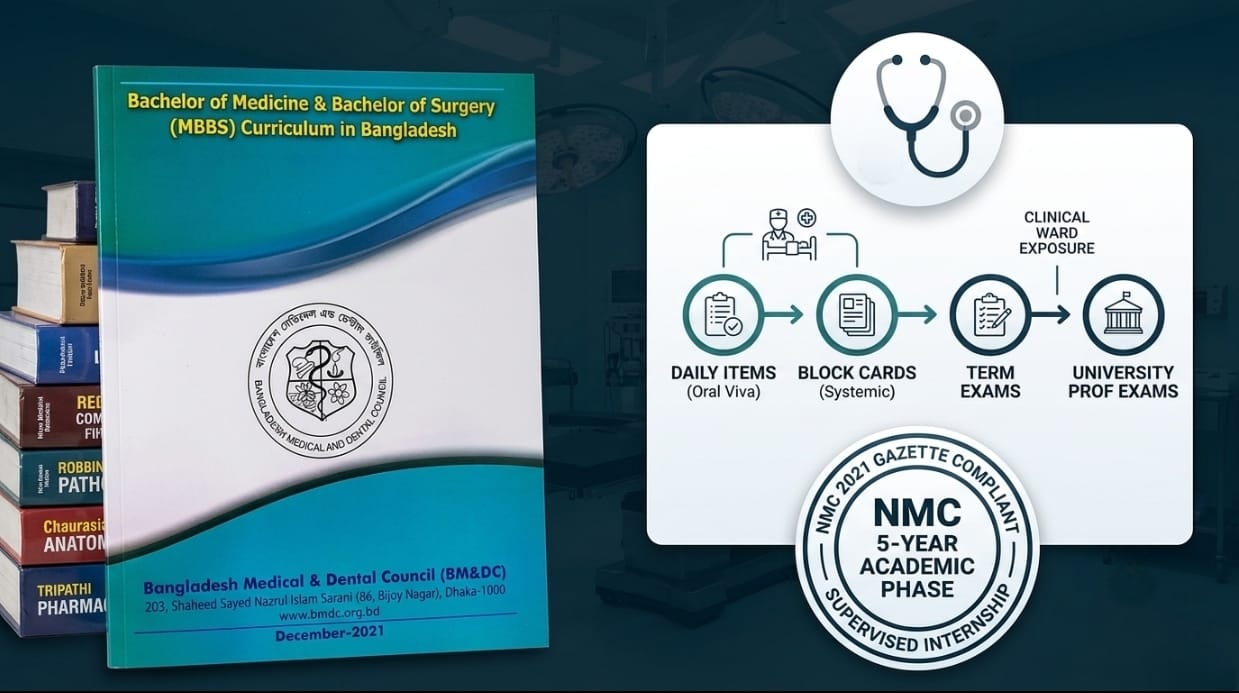
Before I moved to Bangladesh from India to study MBBS, I genuinely did not know what to expect from a Bangladesh MBBS in terms of how the academic system actually works. The fees, the colleges, the NMC recognition, I had researched all of that. But the actual structure of the course, how exams are conducted in Bangladesh, what an “item” is, what a “card” means, why students sometimes get held back an entire semester nobody explained this properly.
Six years later, having lived through every phase of this curriculum including the anatomy bones and dissections, the daily items, the term examinations, the ward postings, and the final professional examination, I want to write the most complete and honest explanation of the Bangladesh MBBS academic system that exists online, the real one that Samad and I and all the Indians and Bangladeshi students have to experience and follow in MBBS in Bangladesh.
This article is for Indian students and families who want to understand exactly what studying MBBS in Bangladesh looks like from the first day in the anatomy hall to the last day of the final professional examination. It is also a direct comparison with the Indian MBBS curriculum, specifically how Maharashtra University of Health Sciences (MUHS), the NMC national framework, and the Delhi medical university structure compare to what BM&DC Bangladesh has designed.
Who Designs the MBBS Curriculum in Bangladesh
The MBBS curriculum followed in Bangladesh is designed and governed by three bodies working in coordination: the Bangladesh Medical and Dental Council (BM&DC), the Centre for Medical Education (CME) under the Directorate General of Medical Education (DGME), and the Ministry of Health and Family Welfare, with technical support from the World Health Organization Bangladesh office.
The current governing document is the MBBS Curriculum 2020 (Updated) officially titled “Curriculum for Under-Graduate Medical Education in Bangladesh — Updated 2020.” This replaced the MBBS Curriculum 2012, which itself had replaced the 2002 curriculum. The 2020 curriculum was implemented for the 2021-22 session onwards. Students from earlier batches including my own batch of 2020-21 follow the older curriculum.
Every private and government medical college in Bangladesh follows the same BM&DC curriculum. The syllabus, the examination pattern, the mark distribution, and the passing criteria are identical across all 61+ medical colleges. This is an important distinction from India, where different universities (MUHS for Maharashtra, Delhi University for certain Delhi colleges, university-specific structures for others) have their own variations on the NMC framework.
Course Duration, Medium and Structure
The Bangladesh MBBS course is structured as follows:
- Name: Bachelor of Medicine and Bachelor of Surgery (MBBS)
- Duration: 5 years academic programme + 1 year mandatory logbook-based rotatory internship = 6 years total
- Medium of instruction: English. All lectures, textbooks, examinations, and clinical notes are in English but Explanations are in Bengali as we share class with local Students.
- Maximum permitted duration to complete: 12 years from the date of first admission
- Prerequisites: HSC or equivalent with Physics, Chemistry, and Biology. Required GPA in SSC and HSC. NEET qualification for Indian students.
- Prerequisite for independent practice: Completing MBBS + 1 year supervised internship → BM&DC permanent registration → eligible for FMGE/NExT in India
The 5-year academic programme is divided into four phases. Each phase has its own subjects, its own examination system, and its own professional examination at the end. Progression from one phase to the next requires passing the professional examination of the preceding phase which means that there is no carry-forward system.
| Phase | Duration | Subjects | Professional Exam |
|---|---|---|---|
| Phase I | 1.5 years | Anatomy, Physiology, Biochemistry | First Professional MBBS |
| Phase II | 1 year | Pharmacology & Therapeutics, Forensic Medicine & Toxicology (+ concurrent clinical exposure) | Second Professional MBBS |
| Phase III | 1 year | Community Medicine & Public Health, Pathology, Microbiology (+ concurrent clinical subjects) | Third Professional MBBS |
| Phase IV | 1.5 years | Medicine & Allied Subjects, Surgery & Allied Subjects, Obstetrics & Gynaecology | Final Professional MBBS |
The Three Layer Assessment System That Sets Bangladesh Apart
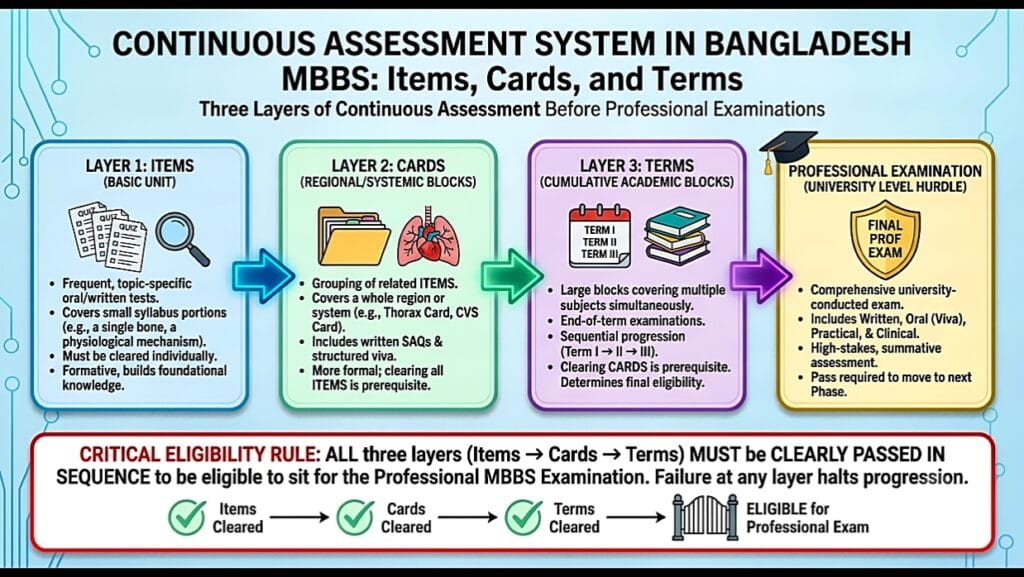
This is the reality that no agent, no brochure, and no standard “MBBS abroad” website explains properly. The Bangladesh MBBS assessment system has three layers of challenges that build on each other before you ever sit in a professional examination hall. Understanding this system is essential for any student coming here, and for any parent trying to understand what their child’s academic life will actually look like.
The three layers are: Items → Cards → Terms. Only after clearing all three layers are you eligible to appear in the professional examination. Let me explain each one in detail using Phase I is the first 1.5 years covering Anatomy, Physiology, and Biochemistry as the primary example, because that is where this system is most intensive.
Layer 1: The Item
An item is the most basic unit of assessment in the Bangladesh MBBS system. Think of it as a daily mini test or class test on a single, specific topic like we used to give in our high schools
In Phase I, items happen almost every day across the three subjects that are Anatomy, Physiology, and Biochemistry. Each department conducts its own items on a rolling schedule. An item in Anatomy might be on the femur bone which has it’s anatomical Positions, its gross anatomy, its attachments, its blood supply, the clinical significance of a neck of femur fracture. An item in Physiology might be on the cardiac cycle. An item in Biochemistry might be on glycolysis or the urea cycle.
The format of an item is primarily a viva that is an oral examination with your class teacher. You sit in front of a faculty member and they question you directly on that specific topic. Occasionally an item includes a short written component, but the viva is the core. This is not a formal examination with invigilation, instead it is a structured academic conversation with your subject teacher, typically conducted during the practical session or a designated item slot and has limited questions most of them are common and important for your professional exams too.
Here is the reality of what this looks like on an ordinary week in first year. On Monday morning, Anatomy has an item on the humerus- you are expected to pick up the bone, identify its parts, name the muscle attachments, describe the radial groove and its clinical significance for radial nerve injury. On Tuesday, Physiology has an item on nerve conduction. On Thursday, Biochemistry has an item on enzyme kinetics. This continues through the entire phase.
What happens if you fail an item? The class teacher gives you a date to re-appear which is sometimes the next day, sometimes during the break period, sometimes in the next practical class. Most teachers are pragmatic about this. They understand that not everyone grasp every topic on the first attempt. The expectation is that you come back prepared and don’t give up. Regularity is the key concept in everything in MBBS here. I have had teachers who said “come tomorrow morning, ten minutes before class” and conducted the re-item right there at the start of lecture. This cooperative flexibility makes the system less frightening than it sounds when you first hear about it and you get to know the questions that were asked to you in the first attempt and what you couldn’t tell so you will have an idea of what was lacking from your side.
But if an item that remains pending, not cleared, blocks your progress toward the next layer. You cannot sit for a card until all the items attached to that card are cleared. This creates a direct incentive to clear items promptly rather than leaving them pending and hoping for leniency later.
Layer 2: The Card
A card is a grouping of related items from a single subject, assessed together as a mid-level examination. Each card covers one anatomical region, organ system, or thematic block. A card exam consists of a written component that is a Short Answer Questions (SAQs) plus a structured viva and OSPE practice too.
Let me give you the most concrete example I can from my own first year in Anatomy.
The Thorax Card in Anatomy covers everything related to the chest region. The items attached to the Thorax Card include individual items on: the ribs (typical and atypical), the thoracic vertebrae, the sternum, the diaphragm with its openings and clinical significance, the lungs and their segments, the heart with its surfaces chambers and valves, the pericardium, the thoracic wall with its intercostal spaces and neurovascular bundles, and the mediastinum (anterior, middle, and posterior). Each of these is a separate item which is a separate viva session with your teacher. There are typically eight to ten items per card, sometimes more depending on the complexity of the region.
Once every item attached to the Thorax Card is cleared, every single one, no exceptions then only you become eligible to appear for the Thorax Card examination itself. The card exam is a step up from items: the written portion tests your integration of knowledge across the entire thoracic region, and the viva in the card exam is more formal, often involving an Associate Professor or even the Head of the Department alongside your regular batch teacher.
Similarly, you have the Upper Limb Card, items on the shoulder joint, the axilla, the arm and forearm muscles, the brachial plexus, the wrist and hand, Radius, Ulna ,Humerus bones, cubital fossa, and all the clinical correlates of upper limb nerve injuries (Saturday night palsy, claw hand, wrist drop). Clear those items, then sit the Upper Limb Card exam.
Other Anatomy cards through Phase I include: Lower Limb, Abdomen, Head and Neck, Neuroanatomy, and Embryology and Histology each with their own set of items and card examinations.
What happens if you fail a card? There is a supplementary card examination which is an additional opportunity to re-sit the card before the term examination. If you fail the supplementary card as well, there is a re-supplementary card opportunity. The system is designed to give students multiple attempts to clear before closing a pathway. But the key point stands that until you pass the card, you are not progressing.
Layer 3: The Term
Phase I has three terms. Each term covers a block of the curriculum across all three Phase I subjects simultaneously that is Anatomy, Physiology, and Biochemistry all have their own term examination at the same time.
To be eligible to sit Term I, you must have cleared all the cards that fall under Term I. To be eligible for Term II, you must have cleared all cards under Term II. And so on through Term III. The terms are cumulative and sequential which means you cannot skip or bypass them.
Term examinations are more comprehensive than card examinations. They cover the full block of curriculum from that term, include a more formal written paper, and carry heavier weightage in your formative assessment record. The formative assessment marks which contribute 10% of marks in each subject’s professional examination are determined by your performance across items, cards, and terms combined, along with your attendance record.
What happens if you fail a term? There is a supplementary term examination and a re-supplementary term examination. The deadlines and scheduling of supplementaries are tight and they are designed to give you a chance to recover without losing the full phase, but they require you to address the failure quickly.
Once all three terms are cleared across all three subjects, along with all cards and all items, and once your attendance meets the 75% minimum in lectures, tutorials, and practicals only then are you eligible to appear in the First Professional MBBS examination.
The First Year in Practice with Bonesets, Museum, Dissection and Daily Items
Let me be honest about what Phase I actually looks like on the ground, because the official curriculum document describes hours and marks but not the lived experience of being a first-year student going through it.
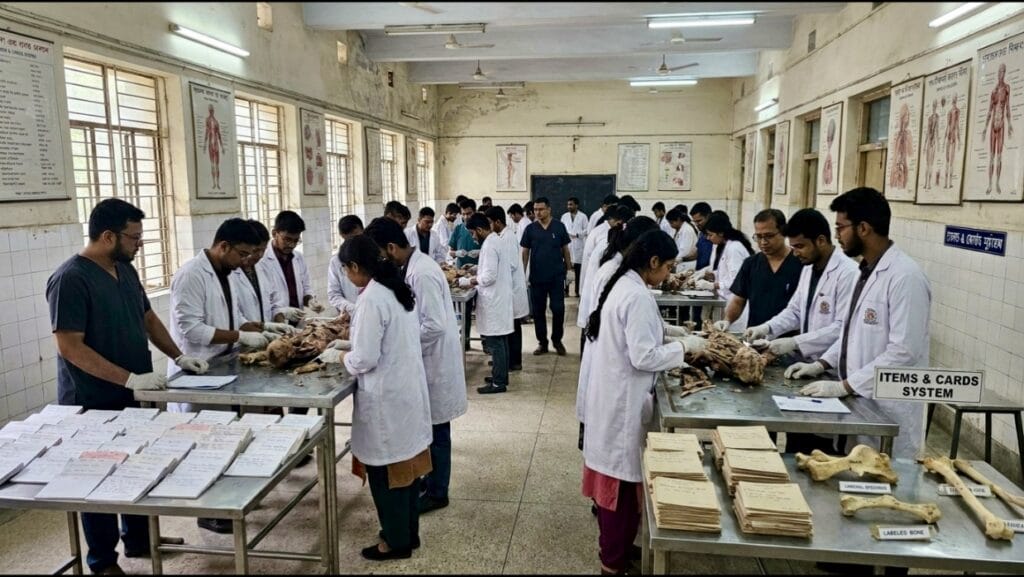
In Anatomy which is the most item-intensive subject in Phase I, you study through three primary channels. First, your bone set: every first-year student purchases a set of disarticulated human bones covering the entire skeleton, and a significant portion of items are conducted using these actual bones. The teacher picks up a bone from your set and asks you to identify it, name a specific feature, or describe the muscle attachments at a particular point. If you do not know your bones, you will not clear your anatomy items. There is no shortcut around this and you need to handle those bones regularly.
Second, the college museum: every Bangladesh medical college has an anatomy museum housing preserved specimens namely viscera, embryological models, histological slides, and cadaveric parts. A significant number of items, particularly those involving viscera like the heart, lungs, liver, and kidneys are conducted using these museum specimens. “Show me the right coronary artery on this specimen.” “Point to the Apex” “Identify this structure.” You learn anatomy by touching and seeing, not just by reading about it.
Third, dissection: throughout Phase I, students perform cadaveric dissection of the human body in the dissection hall. This is scheduled dissection and not optional and attendance is compulsory. You dissect in small groups of four to six students per body but most private colleges have only 2-4 bodies total. The dissection hall is where you see, with your own hands, the structures you have been studying from BD Chaurasia and A.K Dutta. The brachial plexus. The femoral triangle. The perineum. The thoracic duct. There is nothing in a textbook that prepares you for the moment you first see and palpate an actual radial nerve. This is one of the reasons Bangladesh MBBS produces doctors who are comfortable with clinical anatomy they have genuinely seen and touched it.
The honest truth about first year: it is demanding. Not because any individual item is conceptually difficult, most items in Anatomy are memory and identification tasks that become straightforward once you handle the bone or specimen regularly. It is demanding because of the volume and the continuity. Items almost every day. Cards accumulating. Terms approaching. Simultaneously managing Physiology’s cardiovascular and respiratory systems and Biochemistry’s metabolic pathways. The workload in the first semester of Phase I is the most concentrated the entire degree gets.
What I tell every student before they arrive: one to two hours of daily, consistent study is enough to clear every item and card in Phase I. That is genuinely all it takes. The students who struggle and fall behind are almost always the ones who try to study in intensive bursts before card deadlines rather than maintaining daily contact with the material. The system is designed to reward consistency, Regularity and it is honest about that in how it structures the assessment progression.
A significant number of students that I have seen every year since I arrived, go back to India during Phase I because they do not want to give items. They find the daily exams uncomfortable. They were not used to being tested that frequently in school or in their inter years. What I want to say clearly to those students, and to families reading this: this discomfort is the point. The system is designed to build the habit of daily clinical and academic engagement. A doctor who cannot maintain daily engagement with their subject matter is a liability to their patients. The item system builds the foundation of that habit before clinical years begin.
Once you have cleared Phase I and many students describe this as the hardest academic year of their lives, the subsequent phases genuinely feel manageable by comparison. The habit has been built. The system is now familiar. You are thinking like a student of medicine, not like a student trying to get through an examination.
The Professional Examinations: Marks, Format and What Passing Requires
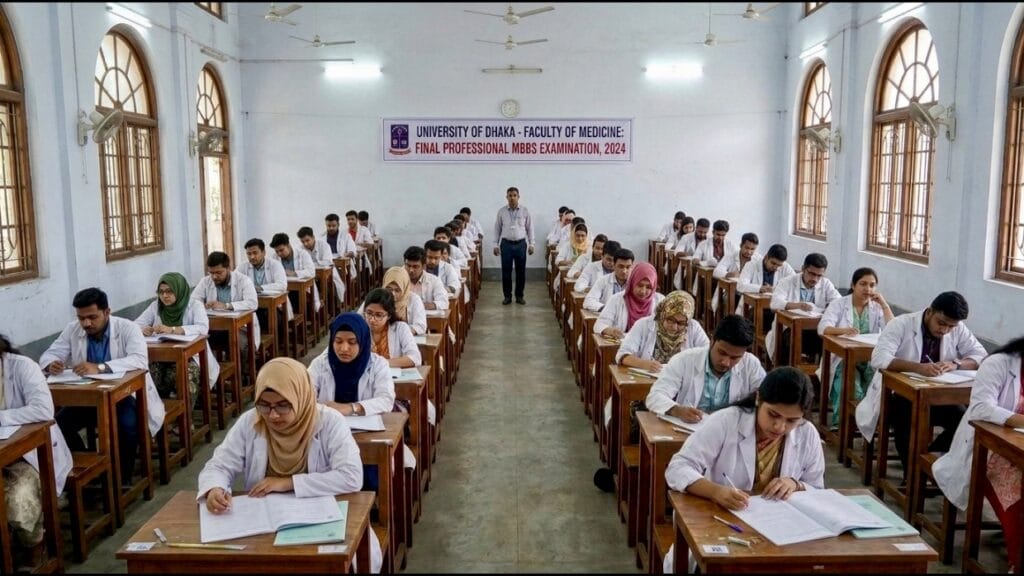
Once you are eligible that is your all items are cleared, all cards cleared, all terms cleared, 75% attendance across all classes and finally you are eligible to appear for the professional examination. This is a university-level formal examination, typically conducted twice a year (May and November sessions) by the affiliated university. The examination is the same structure for all colleges affiliated to that university.
The pass mark is 60% in every component separately, written, oral, practical or clinical. You cannot compensate a low score in one component with a high score in another. This is significantly stricter than India’s 50% aggregate pass mark and means you need competency in each mode of assessment independently.
First Professional MBBS Examination
Subjects and marks distribution from the official BM&DC curriculum:
| Subject | Written | Oral (SOE) | Practical | Formative | Total |
|---|---|---|---|---|---|
| Anatomy | 180 | 150 | 150 | 20 | 500 |
| Physiology | 180 | 100 | 100 | 20 | 400 |
| Biochemistry | 180 | 100 | 100 | 20 | 400 |
| Total | 540 | 350 | 350 | 60 | 1300 |
Notice that Anatomy carries 500 marks which is the heaviest single subject examination in Phase I. This reflects both the volume of material and the intensity of the items/cards/terms system that precedes it. The oral examination in Anatomy carries 150 marks significantly higher than in most Indian university Anatomy examinations, which means your ability to communicate your anatomical knowledge verbally, using actual visceras and bones, is tested with serious authority.
Second Professional MBBS Examination
| Subject | Written | Oral (SOE) | Practical | Formative | Total |
|---|---|---|---|---|---|
| Pharmacology & Therapeutics | 90 | 100 | 100 | 10 | 300 |
| Forensic Medicine & Toxicology | 90 | 100 | 100 | 10 | 300 |
Third Professional MBBS Examination
| Subject | Written | Oral (SOE) | Practical | Formative | Total |
|---|---|---|---|---|---|
| Community Medicine & Public Health | 90 | 100 | 100 | 10 | 300 |
| Pathology | 90 | 100 | 100 | 10 | 300 |
| Microbiology | 90 | 100 | 100 | 10 | 300 |
Final (Fourth) Professional MBBS Examination
The Final Professional is the most heavily marked examination in the entire degree and rightly so, since it determines competency in the three clinical subjects that define a practising doctor. The addition of a clinical component alongside written, oral, and practical separates it from the earlier professional examinations.
| Subject | Written | Oral (SOE) | Clinical | Practical | Formative | Total |
|---|---|---|---|---|---|---|
| Medicine & Allied | 180 | 100 | 100 | 100 | 20 | 500 |
| Surgery & Allied | 180 | 100 | 100 | 100 | 20 | 500 |
| Obstetrics & Gynaecology | 180 | 100 | 100 | 100 | 20 | 500 |
The Written Paper — MCQs, SAQs and SEQs
The written examination in every professional exam follows a specific format that every student here knows intimately by the time they reach final year. Understanding this format matters because it is different from what Indian students experienced in school, and knowing it in advance helps you calibrate your preparation.
The written paper is divided into three question types:
MCQs — Multiple Choice Questions (20% of written marks): The official curriculum specifies a mix of Single Best Answer (SBA) type questions and Multiple True False (MTF) type questions, 50% each. Total of 20 MCQs for 20 marks in each paper. There is a separate answer sheet for MCQs. The MTF format where you judge each statement as true or false independently is more demanding than standard four-option MCQs and tests precision of knowledge rather than recognition.
SAQs — Short Answer Questions (majority of the remaining 70%): These are direct, specific questions requiring a focused written answer typically one to four paragraphs. An SAQ in Medicine might be: “Describe the management of status epilepticus in an adult.” In Surgery: “What are the complications of a femoral hernia?” The emphasis is on factual accuracy and clinical relevance.
SEQs — Structured Essay Questions (approximately 25% of the 70%): Longer, multi-part questions that require you to address a clinical problem from multiple angles — history, investigation, diagnosis, management, complications, and prevention. SEQs in the final professional examination are effectively miniature case discussions in written form. This format directly mirrors the FMGE and NExT examination style.
The oral examination is called the Structured Oral Examination (SOE) which uses a structured question bank with specific topics fixed in advance. Rating scales are used to mark students simultaneously. Every student is asked questions from all topics in the set, and an equal time is given to every candidate. Instruments, clinical specimens, and where applicable, OSPE/OSCE stations are incorporated. This is significantly more structured and standardised than the traditional viva format used in many Indian university examinations.
Attendance rule for MBBS in Bangladesh
The official curriculum is clear on this: a minimum of 75% attendance in all classes is required separately in lectures, tutorials, practicals, clinical ward sessions, and community medicine field postings. This is not an average across components. You need 75% in each category independently, certified by the respective department head before you are declared eligible to sit the professional examination.
In practice, this means you cannot afford extended absences from any component. Missing a week of ward postings in Phase IV has a different attendance calculation from missing lecture days and they are tracked separately. Students who miss clinical placements due to travel home without planning face real eligibility risk. This is worth understanding before you come here: the calendar of classes is not flexible, and attendance tracking in Bangladesh medical colleges is taken seriously at the departmental level.
The curriculum also requires formative assessment clearance: at least 60% marks in formative examinations (items, cards, and terms combined) to be eligible. The formative and attendance eligibility are both verified and certified before the university will issue an admit card for the professional examination. No amount of appealing, no personal contact, and no special arrangement changes this. The system is designed to be impersonal about eligibility — and that is its greatest strength.
What Happens If You Are Ineligible or Fail a Professional Exam
This is something that every parent wants to understand clearly, and where I will be direct.
If you are declared ineligible for a professional examination because of attendance shortage, formative mark deficiency, or pending items/cards/terms then you cannot appear in that examination. You wait for the next examination cycle. University professional examinations are held twice a year (May and November). Being ineligible for the May examination means you wait for November. This is effectively a minimum six-month delay in your academic progression. And in that time you have to cover the shortcomings otherwise you won’t be eligible for the next exam either
If you fail the professional examination in any subject or any component (written, oral, practical, or clinical) then you appear in the supplementary professional examination held in the alternate cycle(May/November). If you fail the supplementary as well, you appear in the next regular session. The curriculum specifies that all professional examination activities must be completed within the time frame of the respective phase, which practically means delays cascade into extended total programme duration.
There is also a no-carry-forward rule for Phase I. A student who fails any subject in the First Professional MBBS examination cannot attend Phase II classes or clinical sessions until they pass all subjects of Phase I. This is stated explicitly in the curriculum: “If any student fail any subject of first phase in the first professional examination he/she will not be able to continue clinical and other classes of second phase before passing first professional examination.”
This is a consequential rule because clinical training in Phase II begins simultaneously with Phase II pre-clinical subjects. A student who is still repeating Phase I cannot access this clinical exposure, which means the learning gap compounds over time. The practical implication: clearing Phase I completely on the first attempt is significantly better than deferring even one subject to supplementary and most of them do clear it.
What does not work in this system: bribery, personal contacts, teacher relationships, political influence, or any form of academic corruption. I want to state this explicitly because the assumption particularly from families who have navigated certain Indian private college environments is sometimes that these things exist here as well. They do not, at the assessment level. The professional examinations are university examinations with external examiners. The eligibility criteria are documented, verified at the departmental level, and submitted to the university. The grading uses structured tools and rating scales. No individual teacher has unilateral authority over a student’s result in the professional examination. Nothing except studying and attending works, and that is the most honest statement I can make about the academic culture of Bangladesh medical colleges.
Phase II and Beyond: How the System Changes After First Year
Phase II is a meaningful transition in the academic experience. The card system does not continue beyond Phase I — Phase II, III, and IV use items and terms, but not the card structure. This reflects the shift in pedagogical approach as the curriculum moves from primarily morphological subjects (Anatomy) into functional, pharmacological, and clinical subjects where regional anatomical chunking no longer structures the syllabus.
What changes significantly in Phase II:
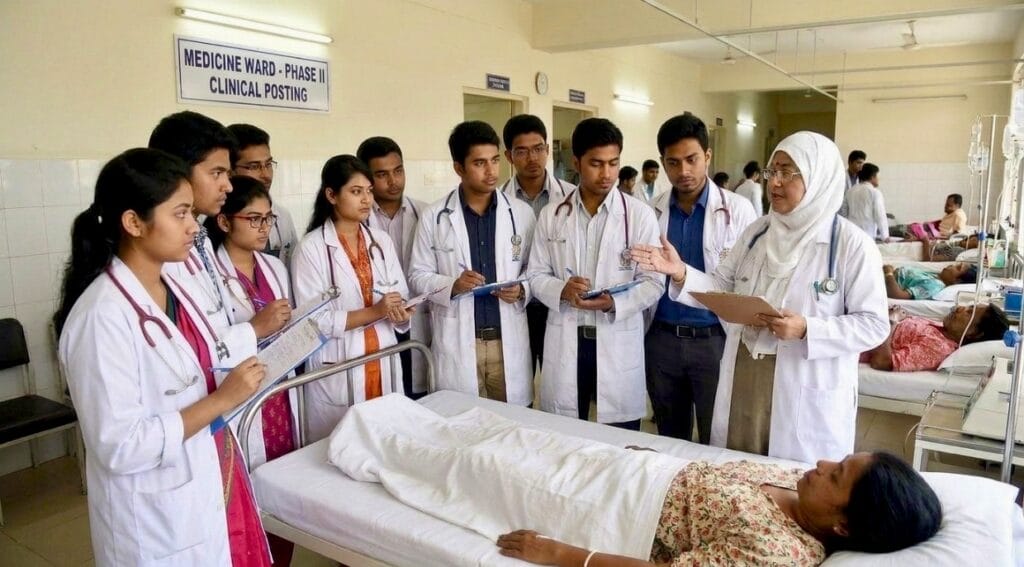
Clinical exposure begins. From Phase II, students attend ward bedside sessions alongside their pre-clinical subjects. The official curriculum allocates 21 weeks of clinical bedside teaching in Medicine and Allied subjects and 20 weeks in Surgery and Allied subjects concurrently during Phase II even though Pharmacology and Forensic Medicine are the examined subjects of this phase. This concurrent clinical training is one of the most well-designed features of the Bangladesh curriculum.
Integrated teaching becomes a formal component. Phase II introduces structured integrated teaching sessions with multi-department sessions covering topics like pulmonary tuberculosis, malaria, poisoning, drowning, and substance abuse from the combined perspectives of Pharmacology, Forensic Medicine, and relevant clinical departments simultaneously. These integrated sessions carry marks in the practical component of the professional examination.
Phase III adds Community Medicine, Pathology, and Microbiology with 37 weeks of concurrent clinical teaching in Medicine, Surgery, and OBG. The community medicine component includes 30 days of community-based medical education which includes 10 days of day visits, 10 days of Residential Field Study Training (RFST), and 10 days of study tour. This community placement is a genuine and structured part of the curriculum, not a box-ticking exercise and We have done it too.
Phase IV which is the final 1.5 years and is primarily clinical. The curriculum allocates 68 weeks of clinical teaching across Medicine, Surgery, and OBG, supplemented by block postings in each department. The integrated teaching in Phase IV covers 42 common clinical topics from hypertension and AKI to DIC, anaemia, and obstetric emergencies and 31 departmental integrated topics. By the time a student reaches the Final Professional examination, they have spent the equivalent of over a year and a half in ward-based clinical learning.
The New BM&DC Curriculum 2020 What Changed and Why It Matters for Your Batch
I study under the older curriculum as my batch of 2020 was admitted before the 2021-22 implementation of the updated curriculum. But students admitted from the 2021-22 session onwards follow the BM&DC Curriculum 2020 (Updated), and the differences are meaningful.
The biggest change: clinical thinking from Phase I. The old curriculum was primarily discipline-based, meaning pre-clinical subjects in Phase I were taught primarily through their own internal logic, anatomy for anatomy’s sake, physiology for physiology’s sake. The new curriculum explicitly integrates clinical context into pre-clinical teaching from the very beginning.
Phase I integrated teaching topics in the new curriculum include: coronary artery disease, COPD, anaemia, diabetes mellitus, jaundice, thyroid disorders, and cerebrovascular disease, all taught from the combined perspectives of anatomy, physiology, and biochemistry together. A first-year student in the new curriculum is expected to understand why the brachial plexus matters for a patient presenting with arm weakness, not just as an anatomical fact.
The new curriculum also introduces Medical Humanities as a formal curriculum component and not optional thing, but assessed sessions on behavioural science, medical sociology, communication skills, doctor-patient relationships, medical ethics, integrity and accountability, medical professionalism, inter-professionalism, and patient safety. These are taught in each phase and contribute to assessment.
Problem-Based Learning (PBL) is more explicitly structured in the new curriculum, and community orientation is strengthened particularly in Phase III with the extended 30-day CBME component. The assessment methodology has also been updated: OSPE/OSCE is more formally embedded, and the SEQ format in written papers has been introduced to replace purely essay-based questions.
For a student choosing between Bangladesh and other foreign destinations, the 2020 curriculum update is a meaningful positive as it produces graduates who are not just knowledgeable about preclinical sciences but who have been trained to think clinically from the beginning of their programme.
Bangladesh vs India | How the Two Curricula Compare in Detail
This is the comparison every Indian family wants, and I want to make it precise and honest rather than promotional. I am comparing the Bangladesh BM&DC curriculum with the NMC-defined curriculum framework as implemented by Maharashtra University of Health Sciences (MUHS) is one of the largest medical universities in India and the general NMC national curriculum competency framework.
Programme Structure and Duration
Both systems are built on the same foundational architecture. India: 4.5 years academic programme + 1 year compulsory internship = 5.5 years total. Bangladesh: 5 years academic programme + 1 year compulsory internship = 6 years total. Bangladesh’s academic programme is six months longer than India’s. This extra semester is allocated primarily to enhanced clinical training in Phase IV — the additional 6 months of ward-based clinical experience in Medicine, Surgery, and OBG is a genuine curriculum advantage for clinical competency.
Subjects
Identical subjects, identical sequence. Both systems cover: Anatomy, Physiology, Biochemistry in the pre-clinical phase; Pharmacology, Pathology, Microbiology, Forensic Medicine, Community Medicine in the para-clinical phase; Medicine, Surgery, OBG, Paediatrics, Orthopaedics, Ophthalmology, ENT, Dermatology, Psychiatry in the clinical phase. The subjects are the same because NMC sets the minimum subject requirements and both systems comply with them.
Textbooks
Identical textbooks. This is the most important fact for FMGE/NExT performance. In Bangladesh medical colleges, Anatomy is taught from BD Chaurasia. Physiology from Guyton and Hall or Ganong. Biochemistry from Lippincott or Harper. Pharmacology from Katzung. Pathology from Robbins. Medicine from Davidson’s and Harrison’s. Surgery from Bailey and Love. These are the exact same primary references used in Indian government and private medical colleges. Your study material is the same as your peers who studied MBBS in India. The examination you sit after graduating that is FMGE/NExT was designed around these textbooks.
The Continuous Assessment System
This is the biggest functional difference between the two systems and the one with the most significant impact on graduate competency.
Indian MBBS assessment under MUHS and most Indian university frameworks includes internal assessment components (typically 20% of total marks across subjects), university professional examinations, and attendance requirements. There is no items/cards/terms system in the Bangladesh sense. Internal assessment in India typically consists of one or two in-course tests per semester, which are formally conducted and contribute to the internals aggregate. The day-to-day assessment pressure in the Bangladesh items model that is a viva almost every day does not exist in the standard Indian MBBS experience.
What this means practically: an Indian MBBS student can theoretically manage their studying in intensive pre-examination bursts, with lower accountability in between university examinations. A Bangladesh MBBS student cannot do this successfully as the item system makes consistent daily engagement the only viable academic strategy.
Pass Marks and Grade System
| Parameter | Bangladesh (BM&DC) | India (NMC / MUHS) |
|---|---|---|
| Pass Mark | 60% in each component separately | 50% aggregate (varies by university) |
| Grade System | GPA (A+ = 4.0 = 80%+) | Pass/Distinction/First Class |
| Minimum Attendance | 75% in each category separately | 75-80% (varies by university) |
| Formative Assessment | 10% of professional exam marks | 20% internal assessment (MUHS) |
| Daily Assessment | Items (daily viva system) | No equivalent daily system |
| Mid-level Assessment | Cards (Phase I) + Terms | 1-2 internal tests per semester |
| Oral Examination Weight | High — SOE with structured rating | Varies — typically lower weighting |
| Clinical Examination | Long case + Short case + OSPE | Long case + Short case + OSPE |
| Medium of Instruction | English — 100% | English (with regional language discussion in some colleges) |
Examination: The Corruption Question
I want to address this frankly because I have had students come to me after spending time in Indian private medical colleges who describe an environment where marks can be influenced by contacts, donations, or personal relationships with faculty. I am not making a generalised statement about all medical colleges that would be unfair. But this question comes up.
In Bangladesh government medical colleges and in the established private colleges I can speak to from personal experience, the professional examination system is conducted with external university examiners who are a faculty from other medical colleges appointed by the affiliated university to conduct oral and clinical examinations. Your own college faculty do not examine you in the professional examination. The written paper is set by the university and marked centrally. The SOE uses rating scales applied simultaneously by multiple examiners. This structure is specifically designed to eliminate examiner bias.
Attempting to influence any of this through personal contacts will not work — not because no one would ever try, but because the system architecture does not give individual faculty the authority to change outcomes in the professional examination. The items and cards are conducted by your own teachers, but even here, a failed item simply means a re-attempt on a specific date — it is not a closed door, and no teacher has the authority to permanently fail you on an item without a genuine academic reason.
Why This System Produces Higher FMGE Pass Rates
The FMGE exam tests whether a graduate of a foreign medical college can demonstrate competency equivalent to an Indian MBBS graduate. The examination covers all subjects from Anatomy to Medicine, requires both theoretical knowledge and clinical reasoning, and is structured around the same textbooks used in Indian and Bangladesh medical education.
The items/cards/terms system means that a Bangladesh MBBS graduate has been assessed on Anatomy items of femur, brachial plexus, thorax multiple times before sitting the First Professional examination. By the time they graduate six years later, they have been continuously and repeatedly tested on every component of the syllabus through daily vivas, card examinations, term papers, and professional examinations. The FMGE is not a new type of test for them it is structurally familiar.
The alignment of textbooks is the other major factor. A student who studied Pathology from Robbins in Bangladesh and a student who studied Pathology from Robbins in an Indian college are reading the exact same disease descriptions, the exact same pathophysiological explanations, and the exact same morphological findings. The FMGE question that asks about the microscopic appearance of a granuloma was answered by both of them from the same source. There is no translation, no adaptation and the preparation is identical.
Combine the continuous exam habit with identical study materials and you have the structural explanation for why Bangladesh consistently produces foreign MBBS graduates with above-average FMGE performance compared to graduates from Russia, China, Ukraine, Kazakhstan, and most other MBBS-abroad destinations.
The GPA System and What It Means for Your Academic Transcript
Bangladesh uses a letter-grade and GPA system for MBBS results, which appears on your official academic transcript from the university. Understanding this matters because your BM&DC registration certificate, your academic transcript, and your university degree certificate are the documents you will present to the NMC and to state medical councils in India when applying for provisional registration after clearing NExT/FMGE.
| Percentage | Letter Grade | Grade Point | Equivalent Status |
|---|---|---|---|
| 80% and above | A+ | 4.00 | Distinction / Top honours |
| 75% to 79% | A | 3.75 | First class |
| 70% to 74% | A- | 3.50 | First class |
| 65% to 69% | B+ | 3.25 | Second class upper |
| 60% to 64% | B | 3.00 | Pass (minimum) |
| Below 60% | F | 0.00 | Fail — must repeat |
Frequently Asked Questions about MBBS Curriculum Bangladesh
What is an “item” in MBBS Bangladesh and how is it different from a regular class test?
An item is a short oral assessment is primarily a viva with your class teacher on a single, specific topic from the current portion of the syllabus. It is more frequent than a class test (occurring almost daily across subjects in Phase I) and less formal than a term examination. The key difference from an Indian-style internal test is that an item is conducted on a rolling basis, individually or in small groups, and must be cleared progressively and failing an item means coming back for a re-assessment before you can proceed to the card. In India, an internal test is typically a formal written examination held once or twice a semester that contributes to the internal assessment aggregate. The Bangladesh item system creates significantly more consistent daily engagement with the material.
What is a “card” in Bangladesh MBBS and which subjects have cards?
A card is a mid-level examination covering a specific anatomical region or thematic block, containing eight to ten related items. To sit a card examination, you must have cleared all items attached to that card. The card exam itself includes written Short Answer Questions and a structured viva. Cards exist primarily in Phase I, particularly in Anatomy and examples include the Thorax Card, Upper Limb Card, Lower Limb Card, Abdomen Card, Head and Neck Card, and Neuroanatomy Card. From Phase II onwards, the card system does not apply, only items and terms continue.
How many terms are there in MBBS Bangladesh and what happens if you fail a term?
Phase I has three terms. Phase II and III each have terms structured around their academic blocks. The number of terms per subject varies by phase. If you fail a term, there is a supplementary term examination which is an additional opportunity to re-sit before the professional examination eligibility is assessed. Failing the supplementary gives one more opportunity: the re-supplementary. Failing all three attempts means you cannot be declared eligible for the professional examination in that cycle, and you wait for the next session.
Can you fail Phase I and continue to Phase II in Bangladesh MBBS?
No, and this is stated explicitly in the official BM&DC curriculum. There is no carry-forward system in Phase I. If you fail any subject in the First Professional MBBS examination, you cannot attend Phase II classes or clinical sessions until you have passed all subjects of Phase I. This is a strict eligibility rule with no exceptions. Students who fail Phase I and proceed to supplementary and re-sit in the next cycle are effectively minimum six months behind their batch in academic progression.
Is MBBS in Bangladesh in English?
Yes completely. The official medium of instruction is English across all phases, all subjects, all lectures, all examinations, and all clinical teaching, but patient interactions and teachers teaching to local student will use Bengali. This is specified in the BM&DC curriculum document. Bangladeshi students and international students (including Indian students) are taught, assessed, and examined entirely in English. This is one of the significant advantages of Bangladesh over non-English MBBS destinations like Russia, China, and Ukraine, where classroom instruction is either in the local language or in English that varies considerably in quality by institution.
What is the difference between the old MBBS curriculum and the new BM&DC 2020 curriculum in Bangladesh?
The old curriculum (2012) was primarily discipline-based and each subject taught largely within its own framework. The updated BM&DC curriculum 2020 is competency-based, community-oriented, and problem-based with integrated teaching from Phase I. Clinical thinking is introduced from the first year through integrated teaching sessions linking pre-clinical content to patient presentations. Medical humanities (communication, ethics, professionalism) are assessed formal components. OSPE/OSCE is more structured. PBL is explicitly incorporated in small group teaching. Students admitted from the 2021-22 session follow the new curriculum; earlier batches follow the 2012 curriculum.
How does MBBS Bangladesh compare to India’s MBBS curriculum for FMGE preparation?
Bangladesh MBBS prepares students for FMGE and NExT through three aligned factors. First, identical primary textbooks (BD Chaurasia, Guyton, Robbins, KD Tripathi, Bailey and Love) — the FMGE and NExT are built around these books, and Bangladesh students use the same ones. Second, the daily items/cards/terms system builds the habit of consistent, detail-oriented study that is directly applicable to the comprehensive nature of FMGE. Third, the enhanced clinical exposure and concurrent ward teaching from Phase II and 68+ weeks of clinical training in Phase IV builds the clinical reasoning skills tested in the clinical component of NExT. Bangladesh graduates consistently outperform graduates of most other foreign MBBS destinations in FMGE pass rates, and the curriculum structure is the primary explanation for this.
A Note for Families Deciding on MBBS in Bangladesh
I want to close this article with something direct, because it is what I wish someone had told me clearly before I arrived.
The Bangladesh MBBS curriculum is genuinely a struggle. Not because it is conceptually impossible, the material is the same medicine taught in India and everywhere else. It is rigorous because of the consistent daily accountability it demands. The items system does not allow you to be lazy. The attendance requirement does not allow you to be selectively present and bunk classes for fun. The professional examination does not allow you to compensate a weak component with a strong one. The no-carry-forward rule means the consequences of not taking Phase I seriously are real and concrete.
None of this should scare you but it should prepare you. A student who approaches this course the way they approached their 12th standard preparation with consistent daily work, regular revision, genuine engagement with the practical sessions will move through this curriculum without significant difficulty. Every student I know who cleared Phase I cleanly says the same thing: first year teaches you how to study medicine. The years that follow feel manageable by comparison because the habit has been formed.
If you are choosing between Bangladesh and another foreign destination for MBBS and you want the most honest, curriculum-based comparison possible this is the page to read and re-read. If you want to talk through which specific college, which city, which fee structure fits your family’s situation, that is a conversation Samad and I have every day on WhatsApp. Not as agents. As people who went through this system and know what it actually takes.

